

When I trained new counter staff in busy community pharmacies, I noticed a pattern: the people who improved fastest were not the ones who did the most questions. They were the ones who could tell me exactly what they kept missing, and why. Practice tests are perfect for that, but only if you use them like a diagnostic tool, not a scoreboard.
This guide walks you through how to take a full-length practice exam under timed conditions, how to dissect every mistake without spiraling, and how to turn that analysis into a tight plan for your remaining study schedule.
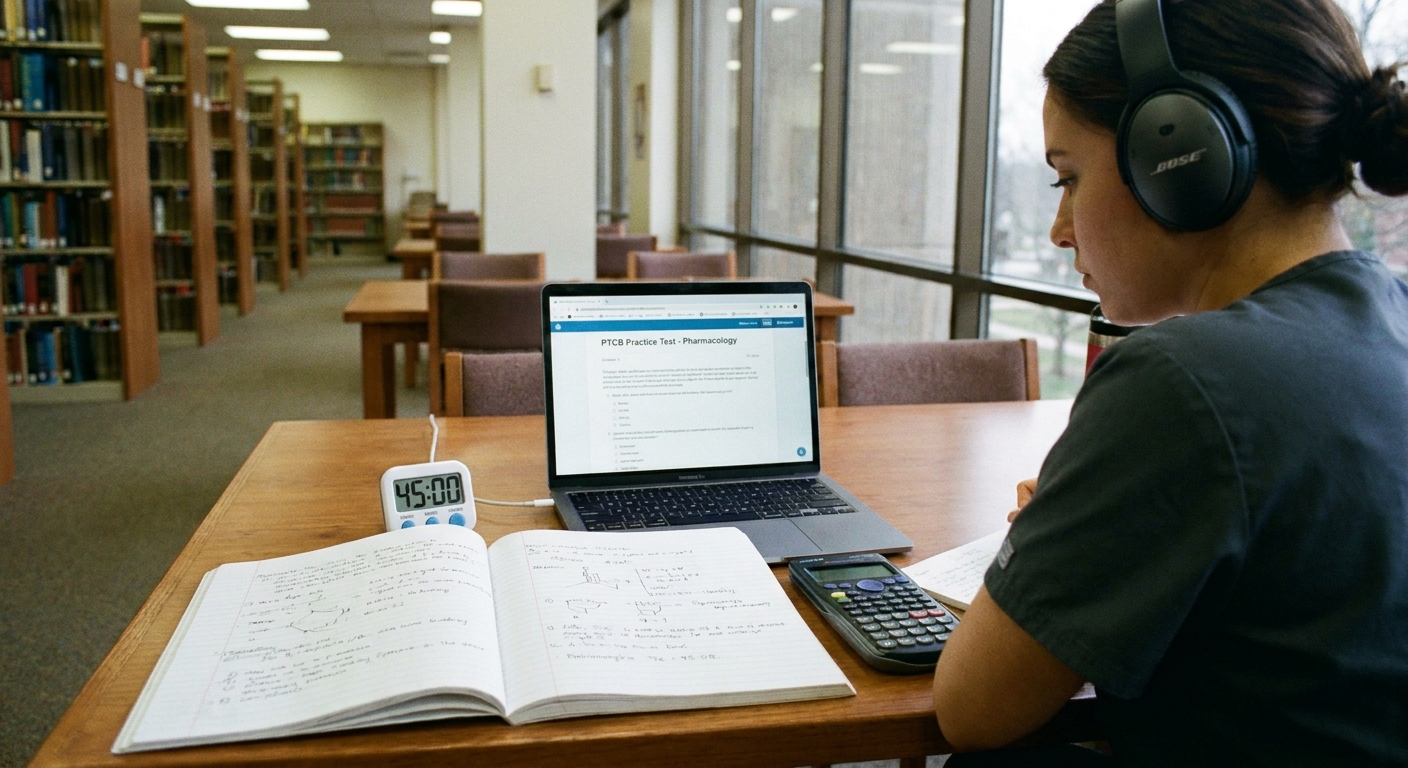
What a practice test is really for
A practice test can do three jobs. Most students only use it for the first one.
- Prediction: “What would I score today?” (useful, but limited)
- Training: “Can I maintain focus and pacing for the whole exam?” (very useful)
- Diagnosis: “Which topics and question types are costing me the most points?” (this is the gold)
Your goal is diagnosis. A score is just a symptom. You want the cause.
Set up a full-length, timed test
If you want weaknesses to show up clearly, you have to create enough realism that your brain cannot hide behind comfort. Here’s the setup I recommend.
Before you start
- Pick a full-length exam from a reputable prep source. If you are switching between resources, keep one “benchmark” source you return to for consistent comparisons.
- Match exam conditions: quiet room, phone away, no music, no pausing.
- Use a basic timer (phone timer is fine if it is in Do Not Disturb and face down).
- Allow only what the exam allows: no drug lists, no notes. Testing rules vary by exam and testing center (including whether you get an on-screen calculator, a basic calculator, and what kind of scratch paper is provided), so confirm your program’s testing policies ahead of time.
Set your pacing target
Before you start the clock, do one quick calculation: time per question.
- Take your total testing time.
- Divide by the number of questions.
- That number is your “planned per-question pace.”
You do not need to hit it perfectly. You just need a realistic pace so you know when you are drifting.
During the test: run a two-pass system
This keeps you from burning time on questions that are designed to slow you down.
- Pass 1 (fast confidence pass): Answer what you know, flag what you don’t. If you cannot choose an answer in about a minute (or your planned per-question pace), make your best guess, flag it, and move.
- Pass 2 (flagged questions): Come back and spend the deeper thinking time where it matters.
Even if your particular exam does not have a formal “flag” button, you can simulate it with scratch paper question numbers.
Track two things while you test
- Time checkpoints: At quarter points, note if you are ahead or behind pace.
- Confidence level: Put a small mark next to question numbers you guessed on, and a different mark for “right, but shaky.” This matters later when you review.

Review wrong answers like a coach
The biggest mistake I see is the “answer key glance.” Students look at the right answer, nod, and move on. That feels productive, but it barely changes future performance.
Instead, do a structured review in three layers.
Layer 1: Categorize the miss
For every incorrect question (and every correct guess or low-confidence correct answer), label it with one primary cause:
- Knowledge gap: I did not know the fact, definition, or rule.
- Concept gap: I know the facts, but I do not understand the why (common in calculations and law).
- Application error: I knew the topic, but I misread, chose too fast, or fell for a distractor.
- Process error: I ran out of time, lost my place, or changed a right answer to a wrong one.
Layer 2: Identify the exact skill
Go one level deeper than the topic name. “Math” is too broad. You want something like:
- Alligation or ratio set-up
- Days supply using package size and directions
- Converting mL to tsp, mg to g, or % strength
- Look-alike sound-alike errors
- Controlled substance schedule recognition
- Storage and beyond-use dating logic
If drug names are a weak area, I recommend pairing your practice test review with a focused memory plan like the one in Memorize the Top 200 Drugs.
Layer 3: Write a one-sentence fix
This is the part that turns review into a study plan. For each miss, write a simple “next time I will…” statement:
- “Next time I will convert units before I plug numbers into the formula.”
- “Next time I will underline the route and dosage form to avoid confusing salts and strengths.”
- “Next time I will eliminate two options first, then decide between the last two.”
Do not skip low-confidence correct answers
These are high-yield because they can flip on exam day when stress is higher. For anything you got right but marked as shaky, do a mini version of the same review:
- What was I unsure about?
- What clue in the question (or rule in the content) would make me confident next time?
- What is the smallest note or flashcard I can make from this?
Build your weakness map
After you review, you should be able to answer two questions:
- What am I missing most often? (frequency)
- What is costing me the most time or confidence? (impact)
Make a simple table in a notebook or spreadsheet with these columns:
- Topic
- Sub-skill
- Miss type (knowledge, concept, application, process)
- # missed
- # guessed
- # low-confidence correct
- Notes on the trap
Even with one full-length test, patterns often start to show up. With a second test, they usually get much clearer.
If your study materials are scattered across apps, printouts, and tabs, it is worth organizing them before you rebuild your schedule. I walk through a clean way to do that in Organise Pharmacy Tech Exam Study Sources.
Turn gaps into a study schedule
Here is the scheduling rule I used when mentoring new staff: study time should follow error data, not vibes. If you missed 8 questions on calculations and 1 on pharmacy law, your next week should not be “evenly balanced.”
A simple weekly structure
- 2 days: Deep work on your top 1 or 2 priority areas (highest frequency or highest impact)
- 2 days: Mixed practice sets (to prevent “I only know this in isolation”)
- 1 day: Targeted review of flashcards and notes made from missed and low-confidence questions
- 1 day: Timed mini-test (25 to 50 questions) focused on your priorities
- 1 day: Rest or light review (short, confidence-building)
If you need a broader overview of what the exams tend to emphasize and how to plan around them, start with Guide: Pharmacy Tech Exam, then come back here to make your data-driven plan.
Use a 70/20/10 rule of thumb
This is a practical split that keeps you honest and prevents over-polishing strengths.
- 70%: Your top gaps (based on missed, guessed, and low-confidence items)
- 20%: Secondary gaps (you are inconsistent, but improving)
- 10%: Strength maintenance (quick mixed quizzes, light flashcards)
Fix common miss patterns
1) You knew it, then changed the answer
- Fix: Only change an answer if you can state a concrete reason, such as “I misread the question” or “I noticed a unit mismatch.”
- Practice: On review, flag every changed answer and write what triggered the change.
2) You missed it because of one word
Words like except, most appropriate, initial, best next step, and contraindicated can flip the whole question.
- Fix: Slow down for the final line. Re-read the question stem before selecting.
- Practice: During review, copy the single word that changed the meaning into your notes.
3) You ran out of time
- Fix: Your issue is usually pacing, not knowledge. Use the two-pass system and accept quick guesses on time sinks.
- Practice: Add more timed mini-tests, not more untimed question banks.
4) Drug names blur together
- Fix: Stop trying to memorize in alphabetical order. Tie drug names to class + common indication + key suffix/prefix.
- Practice: Build tiny “confusion sets” (for example, similar names or same class) and drill those before broad review.

When to take the next full test
Full-length tests are powerful, but they are also expensive in time and mental energy. I like this cadence for most students:
- Baseline: 1 full-length practice test early to find your first set of gaps.
- Build phase: 1 full-length test every 1 to 2 weeks, depending on your timeline.
- Final stretch: 1 final full-length test 5 to 10 days before your exam (early enough to fix what it reveals).
Between full tests, use timed mini-tests to train pacing and keep your weakness map updated.
Quick checklist
- Take a full-length test timed, no pausing
- Mark guessed and low-confidence questions while testing
- Review every wrong answer, every correct guess, and every low-confidence correct
- Label the miss type (knowledge, concept, application, process)
- Write a one-sentence “next time I will…” fix
- Update your weakness map (frequency and impact)
- Rebuild next week’s schedule using a 70/20/10 rule of thumb
If you want extra help deciding which exam path you are preparing for, see PTCB vs ExCPT: Which Pharmacy Technician Exam Should You Take? The better your target, the sharper your practice tests become.