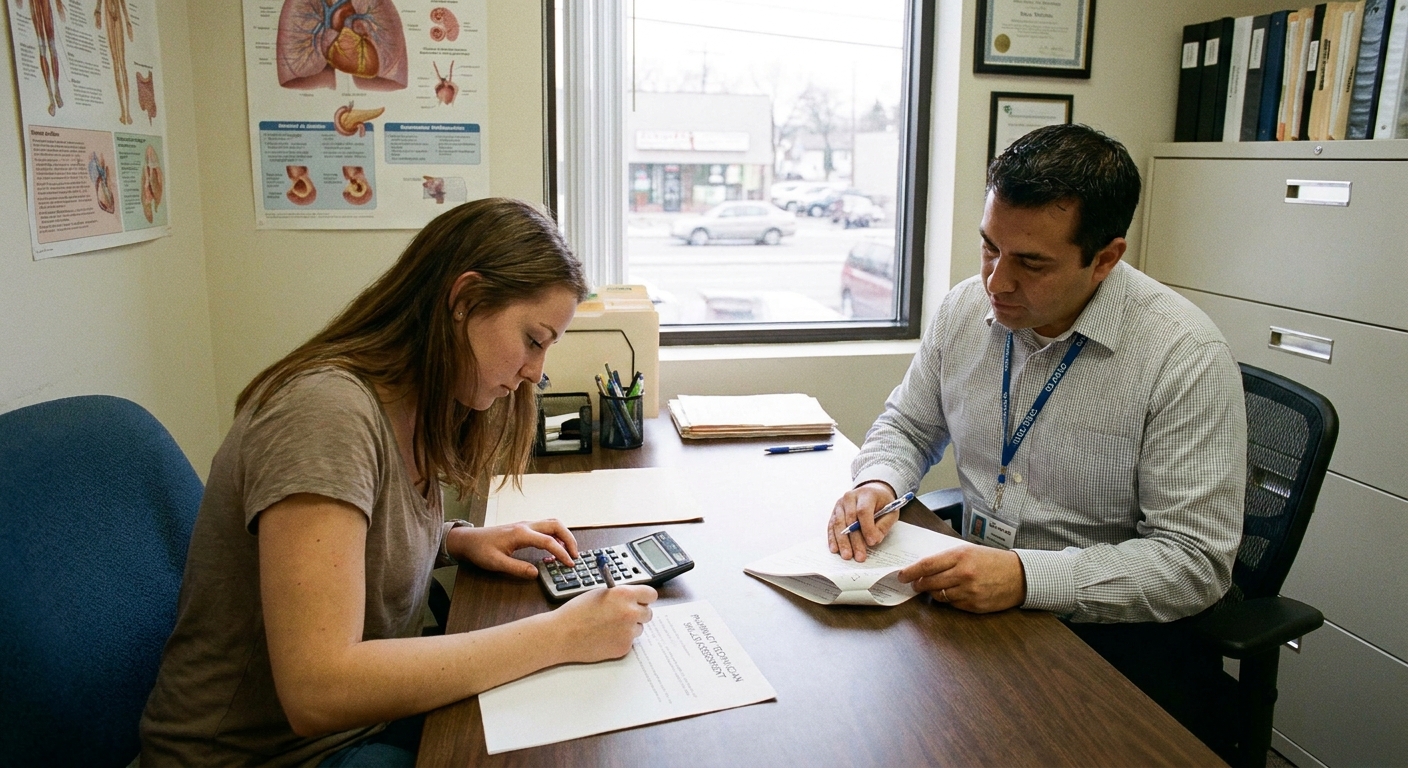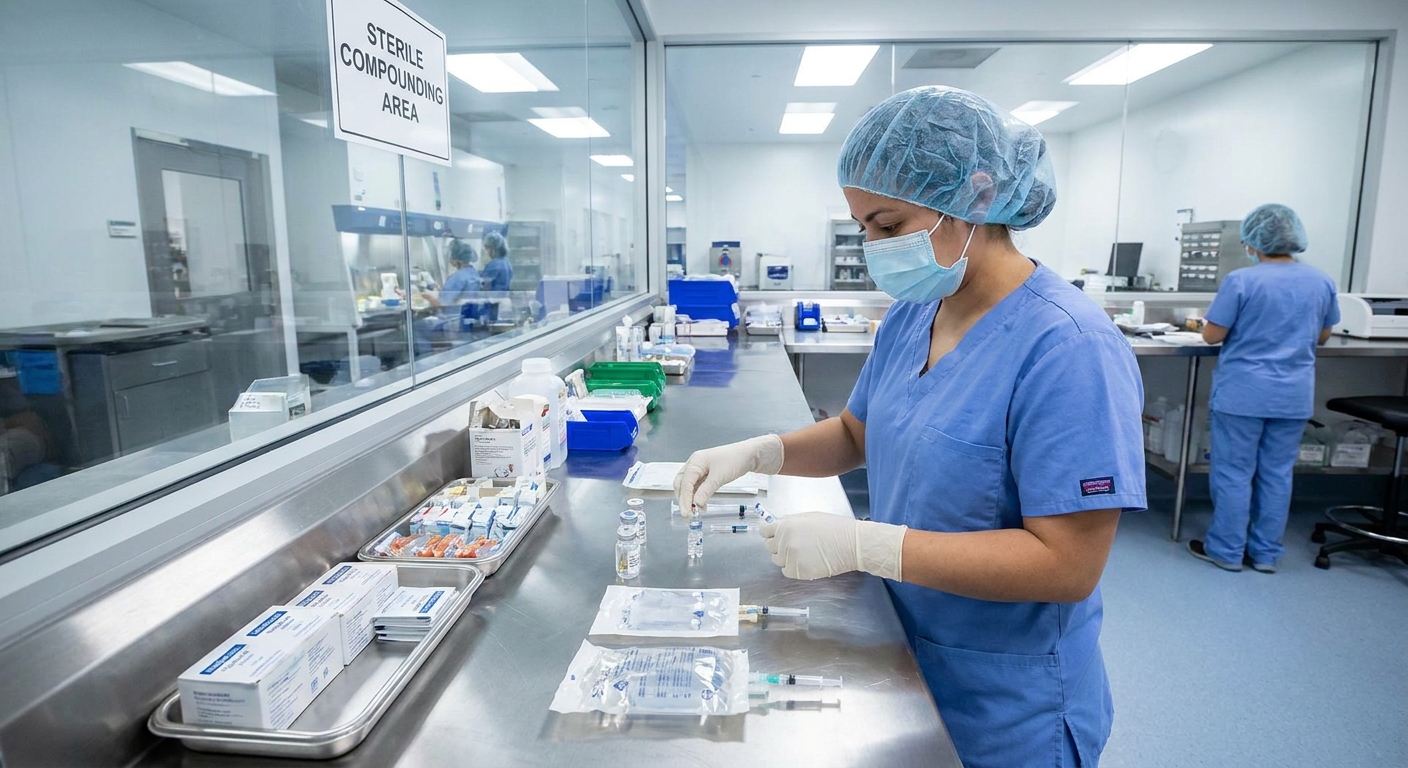

I used to work the front counter in a high-volume community pharmacy where the phones never stopped and the line never got shorter. The techs who looked calm were not “naturally good at math.” They were using the same small set of repeatable moves, over and over, until it felt automatic.
This guide teaches those moves. We will cover the conversion facts you actually use, the most common exam-style question types, and a simple way to set up your work so you catch mistakes before they cost you points.

The 4-step setup I use for almost every problem
If you struggle with pharmacy math, it is rarely the arithmetic. It is the setup. Here is the setup I taught new hires when they were overwhelmed.
- Write what you need (the final unit matters): “mL to give,” “gtt/min,” “tablets per dose,” “mg/day.”
- List what you have: dose on label, concentration, patient weight, time, drop factor, strength per tablet.
- Choose one method: ratio and proportion, dimensional analysis, or formulas. Then stay consistent.
- Do a reason check: Does the answer make sense in size and unit? Is it in a realistic range?
On the exam, clear units are your safety rails. If you keep units visible in every step, many “hard” problems become routine.
For broader exam planning, I also keep a master checklist here: /guide-pharmacy-tech-exam/.
Metric essentials
Most pharmacy calculations live in metric, and most errors happen when people rush the decimal.
Core metric ladder
- 1 kg = 1000 g
- 1 g = 1000 mg
- 1 mg = 1000 mcg
- 1 L = 1000 mL
My decimal rule for the exam
Move the decimal three places when converting between kg and g, g and mg, mg and mcg, L and mL.
- 0.25 g = 250 mg
- 750 mcg = 0.75 mg
- 1.5 L = 1500 mL
Household conversions
Some exams still include common household equivalents. The most frequently tested are:
- 1 teaspoonful (tsp) = 5 mL
- 1 tablespoonful (tbsp) = 15 mL
Use the values provided in your exam materials if they give them. If they do not, these are the standard ones that show up most often.
Dimensional analysis
Dimensional analysis is my go-to recommendation because the units do most of the thinking. You multiply by conversion factors written as fractions so units cancel until you end at the unit you need.
One pressure-tested tip: keep numbers as fractions until the end when you can. It reduces rounding drift and makes it easier to spot unit problems.
How to write conversion factors
If 1 g = 1000 mg, you can write either:
- 1 g / 1000 mg
- 1000 mg / 1 g
You pick the one that cancels the unit you do not want.
Quick example
Convert 0.06 g to mg.
0.06 g × (1000 mg / 1 g) = 60 mg
Notice how “g” cancels and you are left with mg. That is the core idea.
Solid dose calculations
These questions are usually “how many units do you give?” or “how many units do you dispense?”
Tablets per dose
Formula: (Dose ordered) ÷ (Dose available per tablet) = tablets to give
Example 1
Order: 150 mg. Available: 50 mg tablets. How many tablets?
150 mg ÷ 50 mg/tablet = 3 tablets
Example 2
Order: 0.5 g. Available: 250 mg tablets.
Convert first: 0.5 g = 500 mg
500 mg ÷ 250 mg/tablet = 2 tablets
Reason check: If the strength is 250 mg and you need 500 mg, two tablets should feel obvious.
Liquid dose calculations
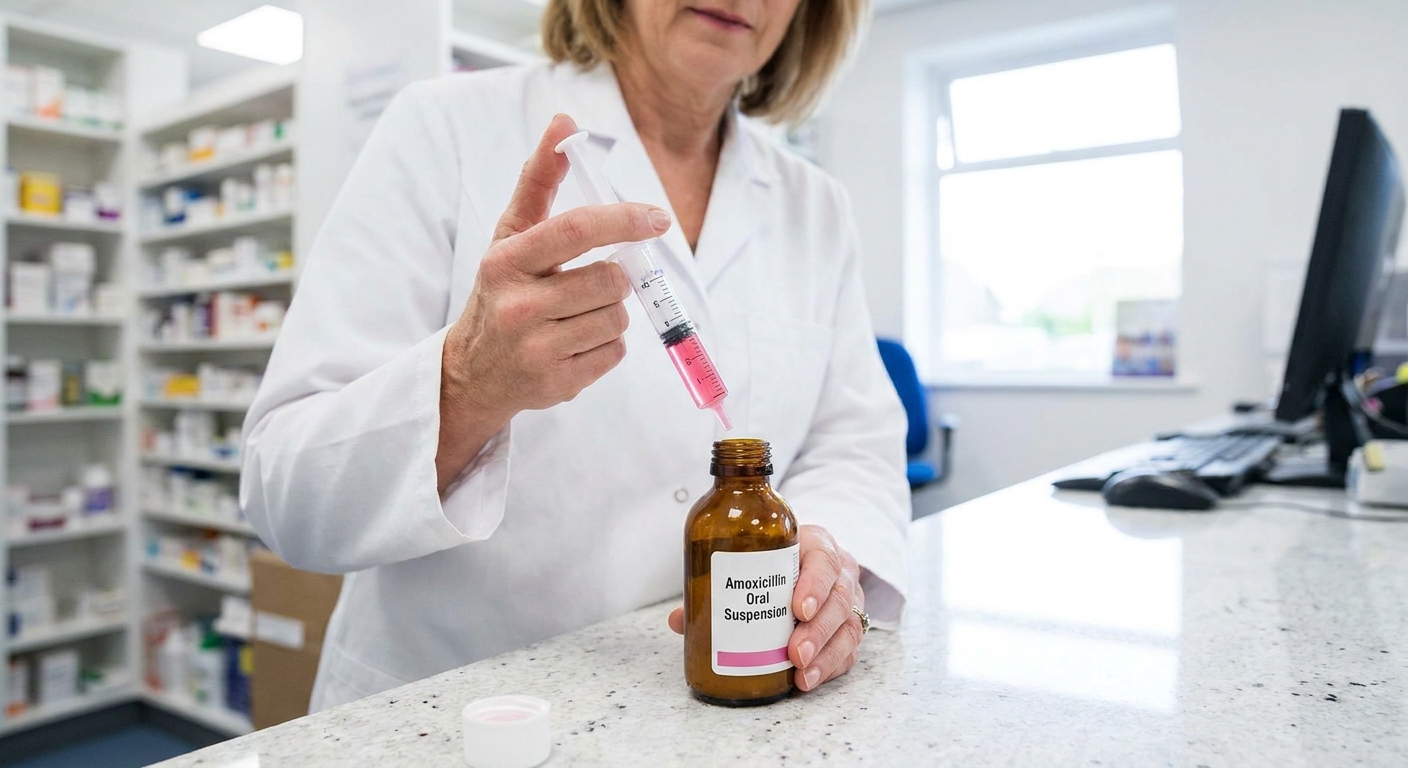
These appear constantly because they mimic real labeling: “Take 10 mL by mouth” based on a concentration like 125 mg/5 mL.
Proportion method
If you have X mg in Y mL, set it up like this:
X mg / Y mL = ordered mg / x mL
Then solve for x.
Example
Order: 300 mg. Available: 150 mg/5 mL. How many mL?
Set up the proportion:
150 mg / 5 mL = 300 mg / x mL
Cross-multiply: 150x = 300 × 5
x = (300 × 5) ÷ 150 = 10 mL
Reason check: Doubling 150 mg gives 300 mg, so you should double 5 mL to 10 mL.
Days supply and quantity
Expect at least a couple of questions where you calculate total volume or total tablets for a set number of days.
Tablets to dispense
Quantity = (tablets per dose) × (doses per day) × (days)
Example
Sig: Take 2 tablets twice daily for 14 days. How many tablets?
2 tablets/dose × 2 doses/day × 14 days = 56 tablets
Liquid volume to dispense
Quantity = (mL per dose) × (doses per day) × (days)
Example
Sig: 10 mL three times daily for 7 days.
10 × 3 × 7 = 210 mL
Reason check: 30 mL/day × 7 days = 210 mL. Same result, two ways.
IV flow rates
Flow rates scare people because they feel clinical, but exam questions usually stick to two standard calculations.
1) Gravity drip: gtt/min
Formula: (mL to infuse × drop factor in gtt/mL) ÷ minutes = gtt/min
Example
Infuse 1000 mL over 8 hours using a set with 15 gtt/mL. Find gtt/min.
- Convert time: 8 hours × 60 minutes/hour = 480 minutes
- (1000 mL × 15 gtt/mL) ÷ 480 minutes = 15000 ÷ 480 = 31.25 gtt/min
Most tests want a whole drop: 31 gtt/min. Rounding instructions vary, so follow what your exam states.
2) Pump rate: mL/hour
Formula: total mL ÷ hours = mL/hour
Example
Infuse 250 mL over 2 hours. 250 ÷ 2 = 125 mL/hour.
Dilutions and concentrations
These show up as percent strength, ratio strength, or “how much stock solution do I need?”
Percent strength
For many exam questions, you can treat percent as “parts per 100.”
- 1% w/v = 1 g per 100 mL
- 0.9% w/v = 0.9 g per 100 mL
Example
How many grams of drug are in 250 mL of a 2% w/v solution?
2 g / 100 mL = x g / 250 mL
x = (2 × 250) ÷ 100 = 5 g
Ratio strength
1:1000 is context-dependent. In exam questions it is usually stated as a specific type (w/v, v/v, or w/w). A common pattern is w/v, meaning 1 g in 1000 mL. For v/v, it may be 1 mL in 1000 mL. Read the wording carefully and use the units they give you.
Example
A 1:1000 solution is described as 1 g per 1000 mL. Convert to mg/mL:
1 g = 1000 mg, so 1000 mg / 1000 mL = 1 mg/mL
Alligation
Some pharmacy tech exams still test mixing two concentrations to get a final concentration. If your program emphasizes alligation, it is worth practicing. The cleanest way for many students is to use a mass balance approach:
(Amount of A × strength A) + (Amount of B × strength B) = (Total amount) × (desired strength)
Then solve for the missing amount.
Pediatric dosing
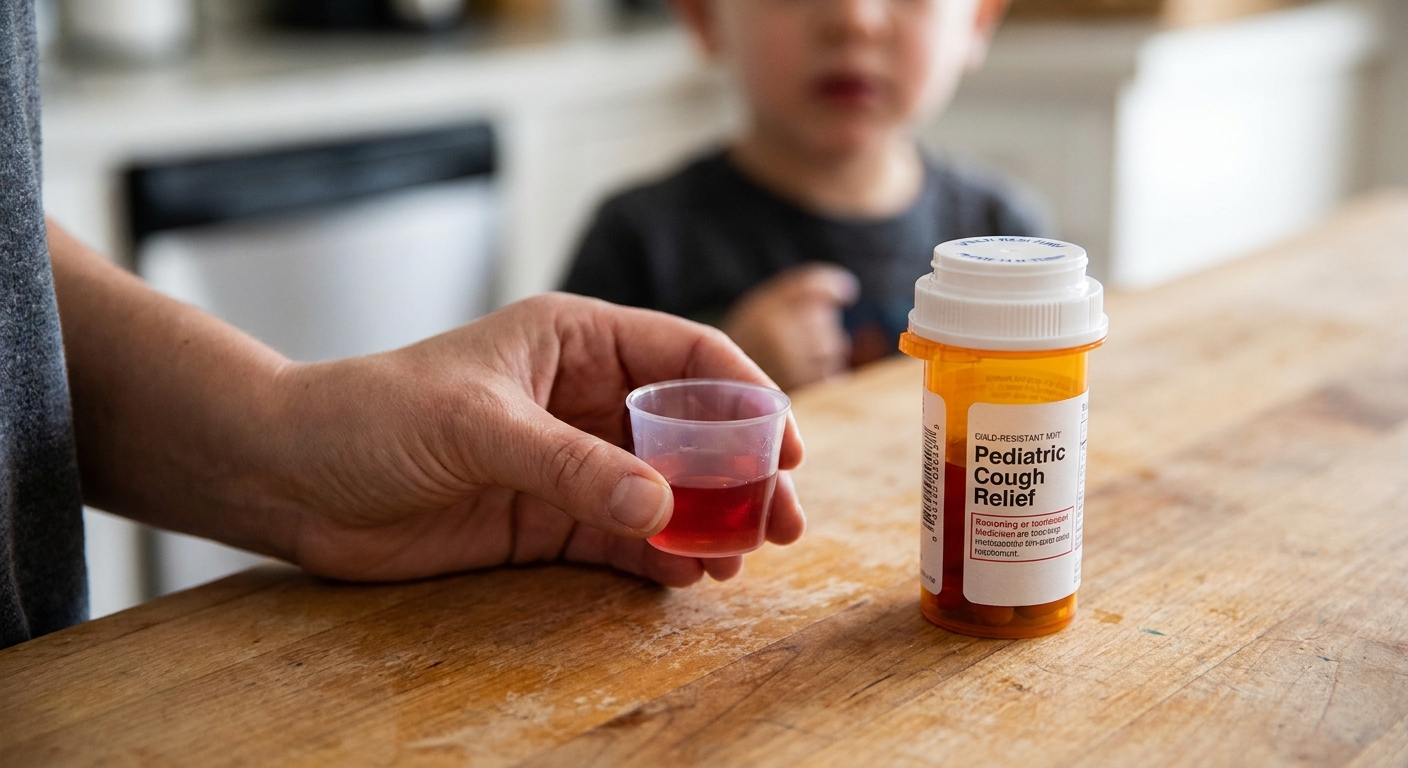
Weight-based dosing is where unit discipline matters most. The two most common exam patterns are mg/kg/dose and mg/kg/day.
Step 1: Pounds to kilograms
kg = lb ÷ 2.2
Example
A child weighs 44 lb.
44 ÷ 2.2 = 20 kg
Step 2: Use the dosing statement exactly as written
Example A: mg/kg/dose
Order: 5 mg/kg/dose. Weight: 20 kg. Find mg per dose.
5 mg/kg/dose × 20 kg = 100 mg per dose
Example B: mg/kg/day in divided doses
Dose: 30 mg/kg/day in 3 divided doses. Weight: 20 kg.
- Daily mg: 30 × 20 = 600 mg/day
- Per dose: 600 ÷ 3 = 200 mg per dose
Step 3: Convert mg per dose into mL (if liquid)
If concentration is 100 mg/5 mL, and the dose is 200 mg:
Set up the proportion:
100 mg / 5 mL = 200 mg / x mL
Cross-multiply: 100x = 200 × 5
x = (200 × 5) ÷ 100 = 10 mL
Insulin basics
Not every pharmacy tech exam emphasizes insulin, but when it appears, questions often focus on reading insulin concentrations and converting units to mL.
Common concentration
- U-100 insulin means 100 units per 1 mL.
Example
How many mL is 25 units of U-100 insulin?
25 units × (1 mL / 100 units) = 0.25 mL
Reason check: 25 units is one quarter of 100 units, so it should be one quarter of 1 mL.
Rounding rules
Rounding trips students because different question types have different expectations.
- Tablets and capsules: Usually round to the nearest whole tablet/capsule, unless directions allow half tablets or the question specifies otherwise.
- mL for oral liquids: Often round to the nearest tenth (0.1 mL) if not specified.
- gtt/min: Typically a whole number because you cannot count partial drops.
- mL/hour pump rates: Often a whole number, sometimes to the nearest tenth depending on the item.
If the exam question tells you how to round, do that. If it does not, choose the practical convention above and be consistent.
Common gotchas
- Mixing mg/kg/day with mg/kg/dose. Always circle “per day” or “per dose” in your head.
- Forgetting to convert hours to minutes for gtt/min problems.
- Skipping the unit in the final answer. Some tests mark that wrong even if the number is right.
- Decimal drift. If your answer changes by a factor of 10 or 1000, pause and re-check metric steps.
- Confusing mL and L and ending up with absurd volumes. The reason check saves you here.
Practice set
Try these without looking, then check your work.
1) Metric conversion
Convert 0.075 g to mg.
Answer: 75 mg
2) Liquid dose
Order 200 mg. Supply 100 mg/5 mL. How many mL?
Answer: 10 mL
3) Tablets per dose
Order 40 mg. Supply 10 mg tablets. How many tablets?
Answer: 4 tablets
4) Days supply
Take 15 mL twice daily for 10 days. Quantity in mL?
Answer: 300 mL
5) gtt/min
500 mL over 4 hours using 20 gtt/mL. Find gtt/min.
Answer: 42 gtt/min (500×20=10000; 4 hours=240 minutes; 10000/240=41.67, round to 42)
6) Pediatric mg/kg/day
Medication is 12 mg/kg/day in 2 divided doses. Child weighs 33 lb. Find mg per dose.
Answer: 90 mg per dose (33/2.2=15 kg; 12×15=180 mg/day; 180/2=90)
How to study pharmacy math
When I trained new staff, the biggest improvement came from short, consistent reps, not marathon study sessions.
- Pick 2 topics per week (example: metric conversions and liquids).
- Do 10 problems a day, timed, with full unit work shown.
- Keep an error log: write the mistake pattern, not just the correct answer.
- Re-test yourself on your error log every few days until those mistakes disappear.
If you need help keeping all your materials organized, I wrote a step-by-step workflow here: /organise-pharmacy-tech-exam-study-sources/. And if you want a broader study approach beyond math, start here: /guide-study-guides/.
FAQ
What is the fastest method for pharmacy math on the exam?
Dimensional analysis is the most consistent under pressure because it forces units to cancel correctly. Ratio and proportion is also fine if you set it up cleanly and keep units visible.
Do I need to memorize a lot of formulas?
No. Most exam questions reduce to a handful of patterns: tablets per dose, mL per dose, total quantity for days supply, mL/hour, gtt/min, and mg/kg dosing. If you can recognize the pattern, the math stays simple.
How do I avoid decimal mistakes?
Write units on every line, convert before you calculate, and do a quick reason check at the end. If your answer seems 10 times too big or 1000 times too small, it often is.