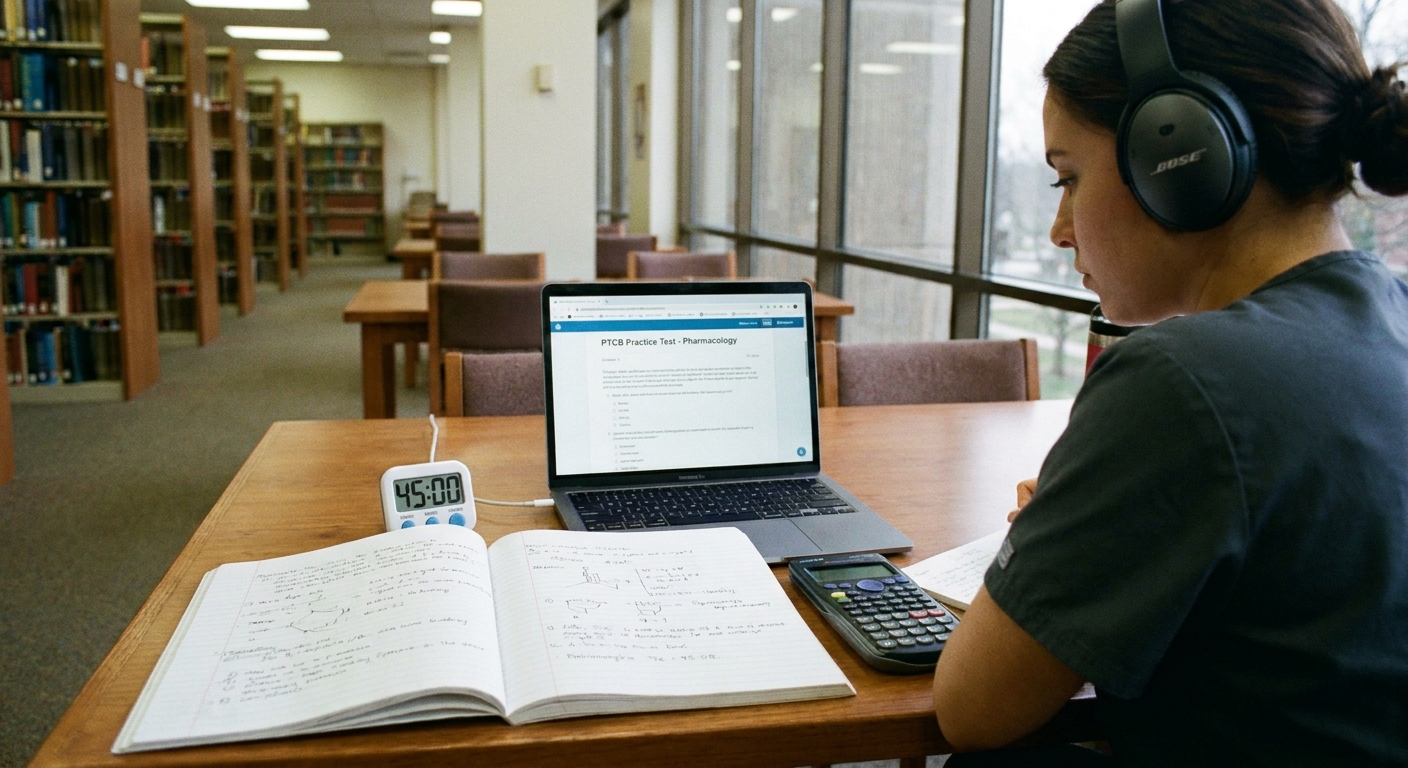

I still remember the first time a new hire at my store told me they failed the PTCB. Their shoulders were up around their ears, like failing meant they were not cut out for pharmacy. But failing this exam usually means something much more ordinary: your prep plan did not match the test plan.
The good news is that a PTCB retake is not a mystery. You get a score report with domain-level feedback, you adjust, and you train the way you would for a busy Monday rush: focus on what actually slows you down, practice under realistic conditions, and tighten your process.

Step 1: Decompress, then review
If you failed, you are going to replay every question in your head. That is normal. It is also not especially productive for the first 24 hours.
My recommendation: give yourself one full day with no studying at all. Sleep, eat like a person, go for a walk. Then come back with a notebook and do a short debrief while your memory is still fresh.
Write down what felt hard first
- Which question types ate your time? Math setups, brand and generic, law wording, sterile compounding details?
- When did anxiety spike? Early, middle, last 20 questions?
- Did you guess because you did not know the content, or because you ran out of time?
- Were you doing mental math when you should have written it out?
This becomes your symptoms list. Your score report becomes your lab results. Together, they tell you what to treat.
Step 2: Use your score report
PTCB score reports can feel vague because you do not get a full item-by-item breakdown. But you do get something useful: performance by exam domain. That is enough to build a targeted plan.
Before you design a new schedule, reread how the exam is structured so you know what each domain includes. If you have not reviewed it recently, start here: The four PTCB exam domains, deconstructed.
How to read domain performance
Think in terms of three buckets:
- Weak domain: You consistently missed concepts or could not recognize what the question was asking. This is where you can gain the most points fastest.
- Shaky domain: You know some pieces but you are inconsistent, especially under time pressure.
- Stable domain: You are generally fine. Maintain it with short reviews so it does not decay.
Most retakers waste their second attempt by starting over evenly across all topics. The score report is telling you not to do that.
Turn feedback into a weekly split
Use this as a starting point for your total weekly study time, then adjust based on your report:
- 50% of study time: weakest domain
- 30% of study time: second-weakest domain
- 15% of study time: everything else, rotating
- 5% of study time: test strategy and endurance (timed sets)
Step 3: Change your method
The most common pattern I saw in community pharmacy was this: someone studies harder the second time, but not differently. More hours, same method.
If your prep was mostly reading, highlighting, and rewatching videos, you probably built familiarity, not recall. And on exam day, doing well requires recall under time pressure.
Use active recall and spaced repetition
If you want one change that tends to move the needle quickly, make it this. Here is the method I recommend and how to implement it: Active recall and spaced repetition for pharmacy techs.
In plain terms, you should be doing more of:
- Closed-book quizzes
- Flashcards where you produce the answer before you see it
- Timed mini-sets (10 to 25 questions)
- Error logs that you revisit every few days
And less of:
- Rereading chapters you kind of understand
- Passively watching content at 1.5x speed without testing yourself
- Taking full practice tests without reviewing why you missed what you missed
Step 4: Build a retake timeline
Most candidates I worked with were balancing shifts, family obligations, and a constantly changing schedule. Your plan has to work on a tired Tuesday, not just a motivated Sunday.
If you need a structured reset, use this as a base and customize it to your weak domains: 30-day PTCB study schedule.
A practical timeline (4 to 8 weeks)
Exact waiting periods and attempt limits can change, so always confirm your eligibility and scheduling rules directly with PTCB. Here is the official starting point: PTCB.org.
That said, many candidates do well with one of these approaches:
- 4 to 5 weeks: if you were close to passing and your issue was mostly strategy, timing, or one weak domain.
- 6 to 8 weeks: if you have multiple weak domains or you did not finish the exam comfortably.
One logistics reminder I wish more people heard early: do not pick a retake date until you have checked your PTCB account for your eligibility window. Motivation is good. Panic booking is not.
What realistic practice looks like
If you only change one thing about your practice, make it more like test day:
- Timed: run sets with a clock, not “when I feel done.”
- Closed-book: no notes, no pausing to look things up mid-set.
- One sitting: build stamina instead of studying in tiny fragments only.
- Scratch work: write setups like you will at the testing center.
- Review after: take as long as you need on review, but keep the attempt itself clean.
A weekly structure that is hard to break
- 3 days per week (30 to 60 minutes): deep work on weak domain, active recall only
- 2 days per week (15 to 30 minutes): flashcards plus quick mixed questions
- 1 day per week (60 to 90 minutes): timed practice set and review session
- 1 rest day: no guilt, no catch-up marathons

Step 5: Use an error log
An error log is not a list of topics you feel bad about. It is a tool for spotting repeatable patterns.
What to capture for every miss
- Domain: use the same domain labels shown on your score report so your review stays aligned with the exam.
- Why you missed it: knowledge gap, misread the question, fell for a distractor, ran out of time
- Fix: one sentence rule or mini-lesson you can review later
- One drill: a quick practice you can repeat (for example, “translate 15 SIGs,” “do 10 days supply problems,” or “work 10 third-party rejection and DAW code scenarios”)
Then revisit the log every 3 to 4 days. If the same why shows up repeatedly, that is your real problem.
Fix the biggest trouble spots
Below are the pain points I saw most often at the counter when people were studying, plus the adjustment that usually helped.
If math sank you
Math issues are rarely about intelligence. They are about setup, unit discipline, and nerves.
- Write units on every line. If units do not cancel cleanly, your setup is wrong.
- Practice conversions until they are automatic.
- Do short timed drills so you stop freezing when the clock is running.
Use this as your core math refresh: Pharmacy math and conversions.
And if your anxiety shows up as shaky math under pressure, this interview-focused guide is still useful because it trains the same skill: solving pharmacy math quickly, cleanly, and with someone watching the clock. Use it like a drill: How to pass the pharmacy technician interview math and skills assessment.
If medications felt like a blur
Do not try to memorize all the drugs as one giant pile. Group them into classes and patterns.
- Learn common stems and what they usually indicate.
- Build small sets of brand-generic pairs and review them daily.
- Prioritize high-frequency classes first.
Start with these two resources: Drug classifications and suffixes and Memorize the top 200 drugs.
If law and ethics tripped you up
Law questions often punish vague thinking. Train yourself to look for the exact trigger in the scenario: who did what, what kind of medication, what record, what time frame.
Build your review around scenarios rather than definitions: Pharmacy law and ethics: what you must know to pass.
If LASA traps got you
These questions test attention and process. In real pharmacy work, that is also where errors happen.
Use this as a focused study session and then drill with mixed questions: LASA medications: avoid mix-ups on your pharmacy tech exam.
If you ran out of time
Time trouble usually comes from one of three things:
- Spending too long on math without writing clean steps
- Second-guessing because you do not have a decision process
- Not practicing timed sets until late in prep
Fix: start doing timed sets now, even when it is uncomfortable. Ten timed questions with review is more valuable than an hour of rereading.
Retake rules: what to do now
Retake rules can vary by program updates and candidate circumstances. So I am going to keep this practical and safe:
- Check your PTCB account for your status and next eligibility window.
- Confirm the current retake policy directly on the official PTCB site: https://www.ptcb.org/.
- Choose your test date after you build a plan, not before. Booking a date can motivate you, but booking too early tends to create panic studying.
If you are unsure whether you should stick with PTCB or consider the alternative certification route, I break down the differences here: PTCB vs ExCPT: which pharmacy technician exam should you take?
Rebuild test day
After a failure, test day can feel loaded. The best antidote is a routine you have practiced.
The week before
- Do one timed mixed set every other day.
- Review your error log, not your entire notebook.
- Stop learning brand-new topics 48 hours before. Switch to review and confidence building.
The day before
- Pack what you need, confirm your route, and plan your arrival time.
- Do one light review session, then stop.
The morning of
Use a checklist so you do not rely on memory when you are nervous: Pharmacy tech exam test day checklist.
And if anxiety was part of the problem last time, build in a pacing rule: every 10 questions, take one slow breath, relax your shoulders, and reset your focus. Simple, not magical, but it keeps panic from stealing minutes.
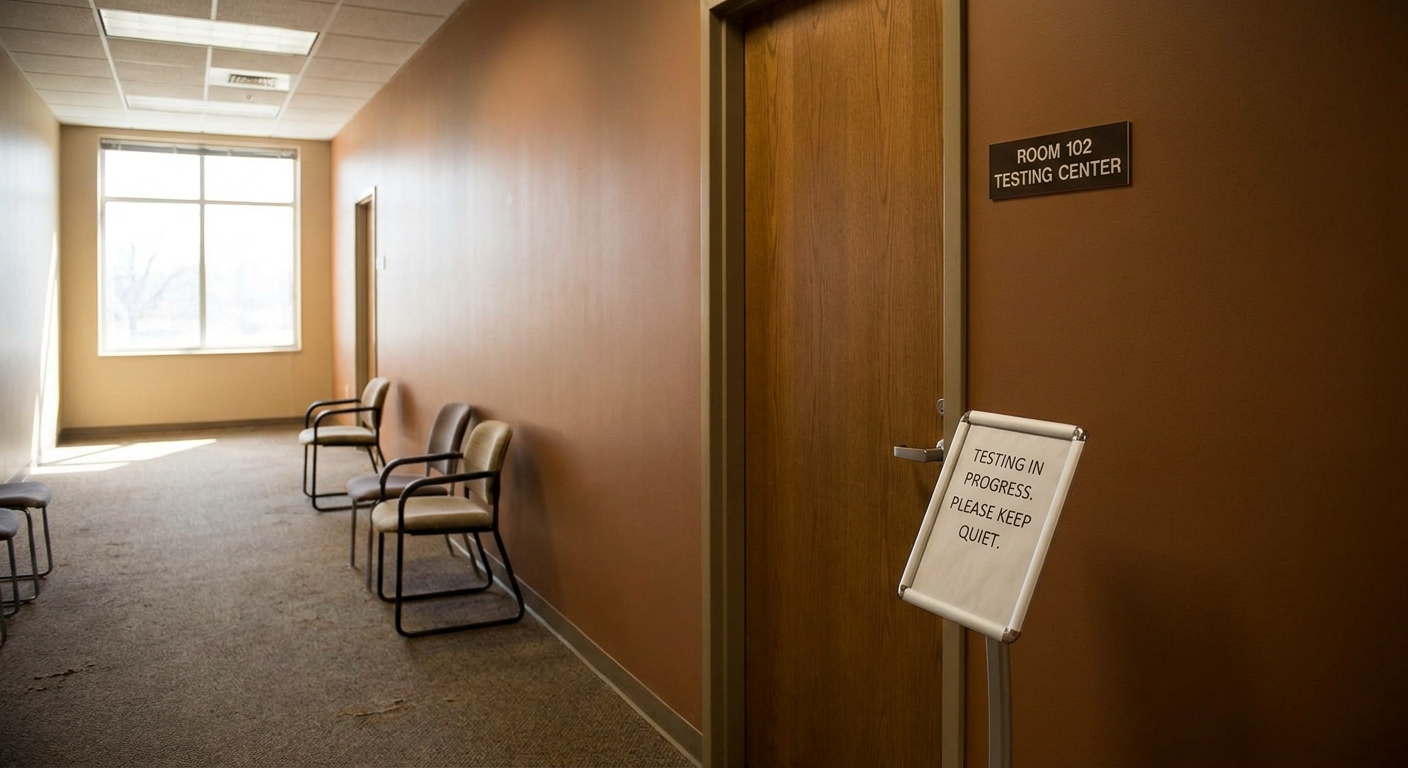
Your next attempt
In a busy pharmacy, you do not get perfect days. You get repeatable systems. Treat your retake the same way.
If you (1) use your score report to pick priorities, (2) switch to active recall, and (3) practice under timed conditions, you will be preparing like someone who expects to pass, not someone who hopes to get lucky.
If you want to tighten your overall approach, start with these two hub pages and work outward:
FAQ
Do I need to start from scratch?
Almost never. Keep what is stable, and concentrate your time where the score report shows weakness. Starting from scratch feels productive, but it spreads your effort too thin.
How many practice tests should I take?
Enough to build endurance and timing, but only if you fully review them. One well-reviewed timed set can teach you more than three tests you never dissect. Use practice tests to find patterns, then drill the patterns. This guide helps you do that: Use practice tests to find your weak spots.
What if I fail again?
It is not the outcome you want, but it is not the end of your pharmacy path. It usually means you need a longer runway, more realistic timed practice, or a different learning method. Recheck the official retake policy, then rebuild your plan with even tighter focus on your error log patterns.