

In busy community pharmacies, I saw the same pattern over and over: a candidate would interview well, then freeze the moment a manager slid a sheet of dosage calculations across the desk. Or they would fly through the math and stumble on a deceptively simple SIG translation. These assessments are not designed to trick you. They are designed to answer one question: can you be safe, accurate, and steady when the pace picks up?
This guide walks you through the most common interview math and skills checks, what employers are looking for, and how to practice in a way that feels a lot like the real thing.
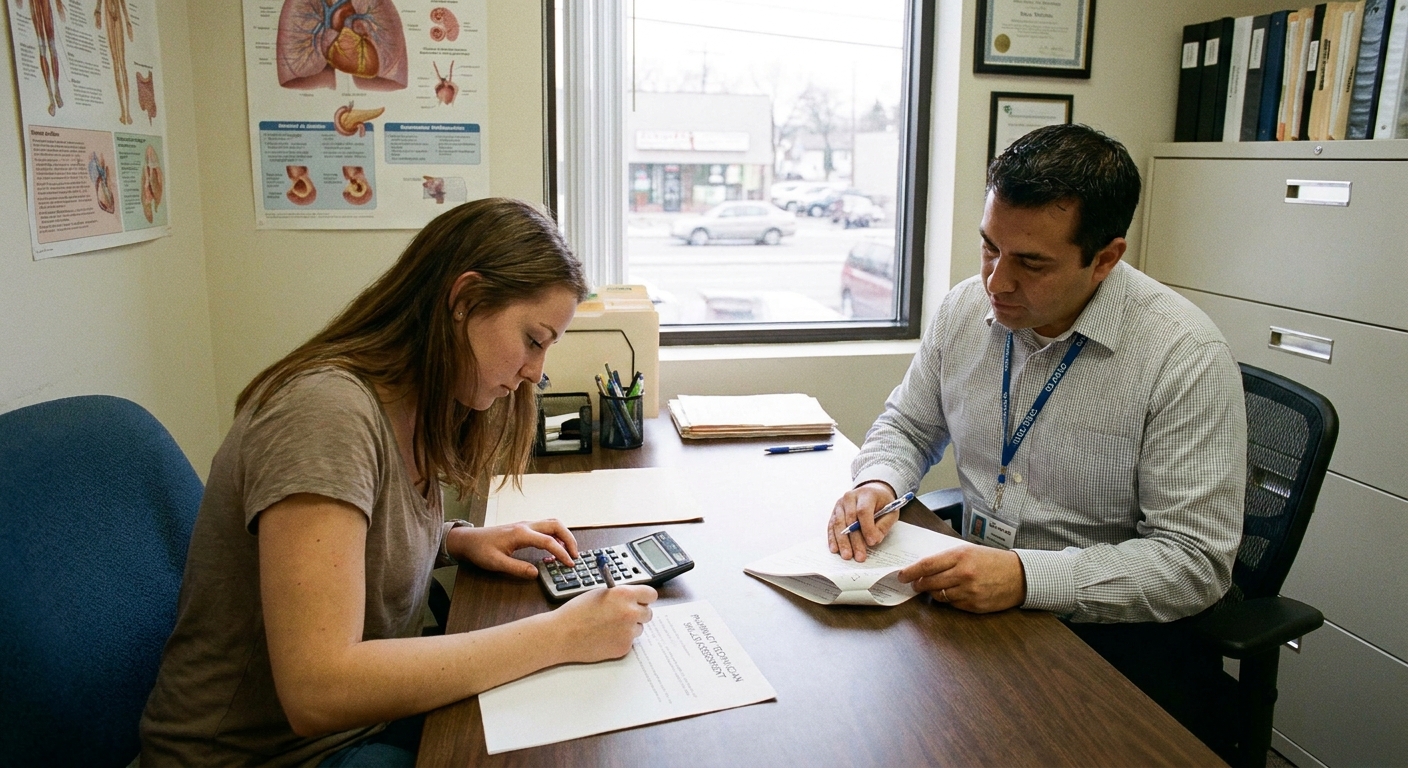
What the assessment is testing
Most pharmacy technician interview assessments aim to measure four things:
- Math accuracy under light pressure (not advanced algebra, just pharmacy-relevant calculations).
- Process thinking (how you set up a problem, label units, and double-check).
- Prescription literacy (SIG codes, abbreviations, and directions that must be translated cleanly).
- Speed with control (typing, data entry, and attention to detail without rushing into errors).
If you want a solid foundation before you drill interview-style problems, start with pharmacy math and conversions and SIG codes and medical abbreviations.
Formats you might see
Employers vary, but most assessments fall into one of these formats:
- Paper test (10 to 30 questions, usually no phone, sometimes a basic calculator allowed).
- Computer test (math plus data-entry simulation, sometimes with a timer).
- Live exercise (the interviewer gives a mock prescription and asks you to read it back or calculate day supply).
- Typing test (words per minute and accuracy, sometimes with pharmacy-flavored text).
Tip: before interview day, ask politely, “Will there be a math or skills assessment, and may I bring a basic calculator?” That question reads as prepared, not needy.
What you can use on test day
Rules vary by employer and even by location, so follow their instructions first. That said, here is what I most often saw:
- Calculator: Sometimes allowed, sometimes provided, sometimes not allowed. If they say “no calculator,” take that literally.
- Scratch paper: Often allowed, and it is your best friend for labeling units and keeping steps clean.
- Showing work: On paper tests, showing your set-up can help if you make one small arithmetic slip. On computer tests, ask if you can keep scratch work.
Math you need most
1) Day supply
Day supply shows up constantly in retail because it impacts billing, controlled substance limits, refills, and prior authorizations. Employers want to see that you can slow down and handle real-world details like maximum daily dose.
Common patterns
- Tablets or capsules: Quantity dispensed ÷ tablets per day.
- Liquids: Total mL dispensed ÷ mL per day.
- “PRN” directions: For day supply, many pharmacies often calculate using the maximum daily usage, but payer rules, state law, store policy, or prescriber clarification can override that. On an interview test, use what the question tells you. If it is ambiguous in a live exercise, say how you would confirm policy.
Practice examples
- Example A: “Take 1 tab PO BID.” Quantity: 60 tabs. Tabs per day: 2. Day supply: 60 ÷ 2 = 30 days.
- Example B: “Take 1 to 2 caps PO TID PRN.” Quantity: 90 caps. Max caps per day: 2 × 3 = 6. Day supply: 90 ÷ 6 = 15 days.
2) Ratio and proportion dosing (especially liquids)
If you can set up a proportion with labels, you can do most interview calculations safely.
Clean set-up pattern: (Strength you have) / (Volume you have) = (Dose you want) / (Volume you are solving for)
- Example: Amoxicillin 250 mg/5 mL. Order: 500 mg. How many mL?
- 250 mg / 5 mL = 500 mg / x mL
- x = (500 × 5) ÷ 250 = 10 mL
3) Conversions you must know
Interviewers love conversions because they reveal whether you keep units straight.
- 1 g = 1,000 mg
- 1 mg = 1,000 mcg
- 1 tsp = 5 mL
- 1 tbsp = 15 mL
- 1 oz (fluid) ≈ 30 mL (many pharmacies use 29.57 mL, but interview problems typically round)
Need a refresher with practice structure? Use Pharmacy Math and Conversions as your base, then come back here and simulate timed sets.
4) Percentage strength (common in creams and solutions)
Many tests include at least one “What does X% mean?” question.
- 1% w/w is often treated as 1 g per 100 g (common way to think about creams/ointments).
- 1% w/v is often treated as 1 g per 100 mL (common way to think about solutions).
In interviews, you will not always see w/w vs w/v stated. Many questions assume creams use g/100 g and solutions use g/100 mL, so read the dosage form and answer accordingly.
Example: Hydrocortisone 1% cream, 30 g tube. How many grams of hydrocortisone in the tube (conceptual)?
1% of 30 g = 0.01 × 30 = 0.3 g (which is 300 mg).
5) Hospital-style rate basics
Not every employer will ask these, but inpatient roles sometimes do. For pharmacy tech interviews, I saw more focus on mL/hr, concentrations (mg/mL), and dose-rate thinking than nursing-style drip factors.
- mL/hr = total mL ÷ hours
- Concentration (mg/mL) = total mg ÷ total mL
- gtt/min questions can still appear: gtt/min = (mL/hr × drop factor) ÷ 60
If you are interviewing for inpatient, also review hospital vs retail scenarios so you are not surprised by the workflow language.
Rounding and common conventions
Rounding rules can vary by system and payer, but interview tests usually want safe, practical answers:
- Day supply: Typically expressed in whole days. If you get 7.5 days, many teams round down to 7 for billing, but some scenarios may round up depending on policy. If it is a live question, say what you would do and why, then note you would follow payer or store rules.
- mL: Often rounded to a sensible tenth when measuring doses, unless the question asks for a specific precision.
- Decimals: Treat them like a safety issue. A clean, clearly written decimal is part of the skill.
Prescription translation
Prescription translation exercises are usually straightforward, but they punish sloppy reading. The most common tasks are:
- Expand SIG abbreviations into plain English.
- Clarify route and dosage form.
- Identify missing or conflicting information.
- Calculate day supply from the SIG.
SIG translation examples
- “1 tab PO QD” = Take 1 tablet by mouth once daily.
- “2 puffs inh QID PRN wheeze” = Inhale 2 puffs four times daily as needed for wheezing.
- “Apply AA BID” = Apply to affected area twice daily.
If you want the fastest confidence boost, drill the common abbreviations in SIG codes and medical abbreviations, then practice turning them into complete sentences.

Typing and data entry
Typing assessments for pharmacy tech roles are rarely about being the fastest person in the building. They are about being fast enough while staying accurate with medication names, strengths, and directions.
What employers often measure
- Words per minute: Some employers set a baseline. A common range I have seen for entry-level roles is roughly 35 to 45 WPM, but it varies widely.
- Accuracy: A single wrong digit in a strength matters more than a missed comma.
- Number-entry control: Decimals, trailing zeros, and leading zeros.
A simple practice plan (15 minutes a day)
- 5 minutes: general typing warm-up.
- 5 minutes: type pharmacy-like strings: drug name + strength + dosage form + quantity.
- 5 minutes: type SIG translations you write yourself (from common abbreviations).
When you practice, treat accuracy like a safety habit. Slow down slightly and aim for clean entry, then build speed.
Common traps
Decimals and zeros
- 0.5 mg should be read carefully. A missed decimal can create a serious error.
- Avoid adding unnecessary trailing zeros in a way that could be misread. Many systems handle formatting, but your mindset matters.
PRN directions
For day supply, PRN often means you calculate using the maximum daily dose for billing, but this is not universal. If a live scenario feels unclear, the safest answer is to explain what you would check (store policy, plan rules, or a clarification from the pharmacist).
Unit mix-ups
mg vs mcg, mL vs tsp, grams vs milligrams. Label your numbers as you work, even on a timed test. “5” is useless. “5 mL” is safe.
Look-alike, sound-alike names (LASA)
Interviewers may slip in similar drug names to see if you read precisely. If you have not reviewed this recently, spend time with LASA medications and how to avoid mix-ups.
Simulate the test
Confidence comes from rehearsing the conditions, not just the content. Here is the simulation I used to recommend to new hires studying for internal competency checks.
The 3-round simulation
- Round 1 (untimed): Do 10 math questions. Write units on every step.
- Round 2 (lightly timed): Do another 10. Give yourself 20 minutes. No interruptions.
- Round 3 (mixed skills): 5 math questions + type 5 SIG translations + spot 5 “error checks” (see below), all in 25 minutes.
Add an error-check section
Create a mini checklist and practice catching problems like:
- Strength mismatch: “Take 2 tablets daily” but strength entered does not match what was prescribed.
- Quantity mismatch: Quantity is 30, directions read like a 60-day supply.
- Missing basics: No route or no frequency in the directions.
- Duplicate therapy: Two meds from the same class that raise a question for the pharmacist.
This pairs well with the mindset in medication error prevention and QA strategies, because interviews reward safe thinking as much as speed.
Mini practice set
Use these to build speed. Do them on paper first, then time yourself. Answers are included so you can check your work.
Questions
- “Take 1 tab PO TID.” Qty 90 tabs. What is the day supply?
- Ibuprofen suspension 100 mg/5 mL. Order: 200 mg. How many mL per dose?
- Convert 0.25 g to mg.
- Albuterol inhaler: “Inhale 2 puffs q4-6h PRN.” In a day-supply calculation, what is the maximum puffs per day using q4h?
- 1% solution (assume w/v). How many grams are in 120 mL?
Answers
- 30 days
- 10 mL
- 250 mg
- 12 puffs/day (2 puffs × 6 doses)
- 1.2 g
During the assessment
Ask to show your work
If the test is on paper, show your set-up. If it is on a computer, use scratch paper if allowed. Employers like candidates who are transparent and consistent.
Talk through your process (live exercises)
You do not need a monologue. A simple, calm narration is enough:
- “I’m calculating day supply using the maximum daily dose because it is PRN, and I would confirm policy if this were a real claim.”
- “I’m converting grams to milligrams first so the units match.”
If you get stuck, do this
- Rewrite the problem with units.
- Estimate what a reasonable answer range should be.
- Check whether you accidentally flipped a ratio.
Guessing fast is not impressive in pharmacy. Re-centering and correcting yourself is.
Retail vs hospital focus
Retail interviews
- Day supply, billing logic, quantity calculations.
- SIG translation and patient-friendly directions.
- Data entry accuracy and customer-facing composure.
Hospital interviews
- Stronger emphasis on unit conversions, concentrations, and medication safety language.
- Scenarios around order workflow and preventing errors.
To align your prep with the role, review hospital vs retail scenarios and think about the kinds of mistakes each environment cannot afford.
One-week prep plan
- Day 1: Conversions and measurement basics (30 minutes).
- Day 2: Day supply drills (20 to 30 minutes).
- Day 3: Ratio and proportion, liquid dosing (30 minutes).
- Day 4: SIG translation set, read out loud (20 minutes) + typing practice (10 minutes).
- Day 5: Mixed set simulation (30 minutes).
- Day 6: Review errors, redo missed problems (30 minutes).
- Day 7: Light refresh only, then rest.
If your schedule is packed, you may also like how to balance pharmacy study with a full-time job. The tactics work just as well for interview prep.
Interview day checklist
- Bring a basic calculator if permitted.
- Bring two pens and a small notepad (even if the test is on a computer).
- Sleep and eat something steady beforehand. Math feels harder when you are running on empty.
- On every problem, label units and sanity-check your answer.
- If it is timed, do a fast pass first: answer what you know, then return to the slower questions.
For broader interview readiness beyond the assessment, I keep a full hub at Job Interview Tips, and if you want to rehearse the conversation itself, use top interview questions and how to answer them.

FAQ
Do pharmacy technician interviews always include a math test?
No. Some employers do a formal test, some do a few verbal questions, and some rely on probationary training. But because medication work is number-heavy, it is common enough that you should prepare for it.
What score do I need to pass?
It depends on the employer and role. Many are looking for strong fundamentals and safe habits, not perfection. One careless decimal mistake, though, can outweigh several small errors.
What if I have not used pharmacy math in a while?
Start with conversions and day supply, because those show up the most. Work slowly for accuracy first, then introduce a timer. The foundation guide on pharmacy math and conversions is a good reset.