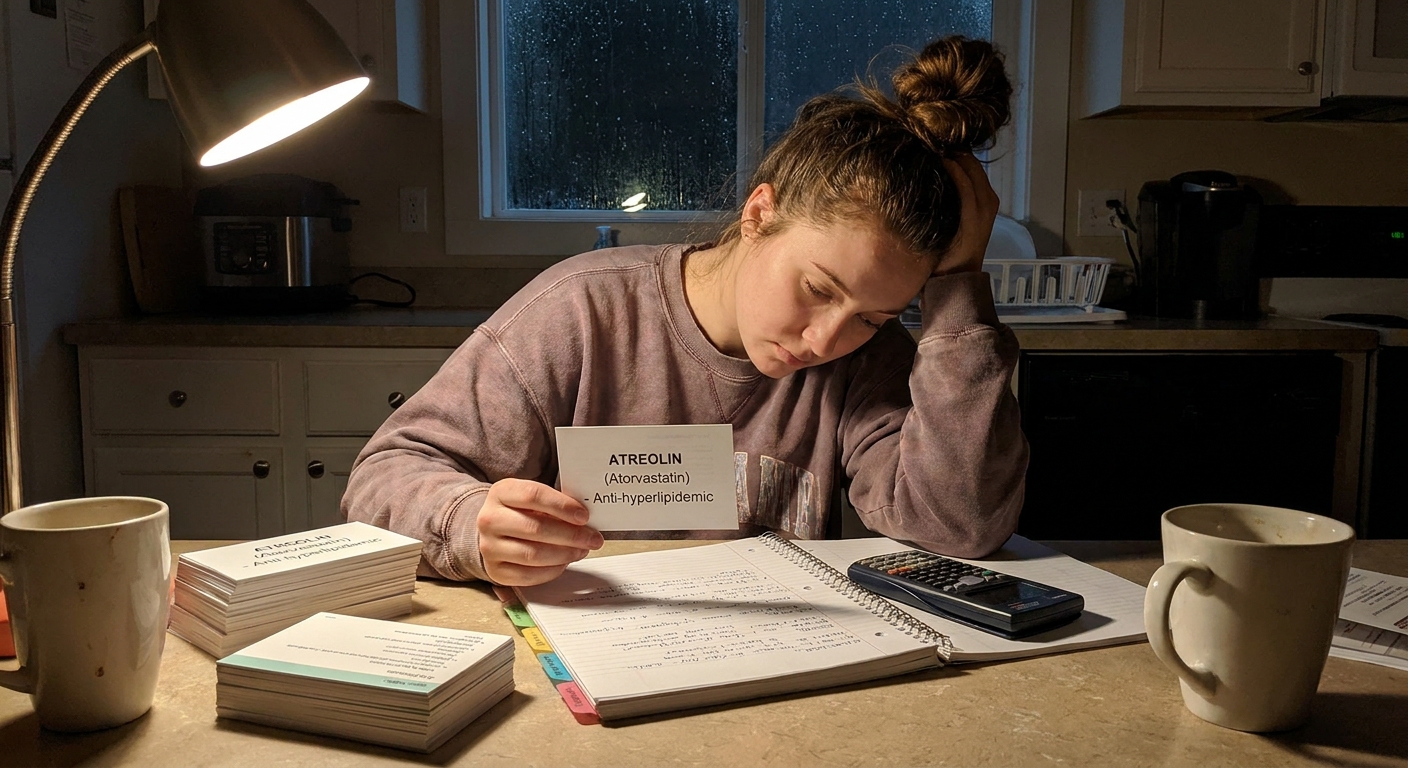

I trained in retail, but I spent enough time talking shop with hospital techs (and onboarding new hires who had done rotations) to notice a pattern: most test-takers do not struggle with the drug, they struggle with the setting.
On the pharmacy tech exam, the question is often really asking, “Where are we right now?” Hospital and retail both dispense medications, but the workflow, priorities, and even the meaning of a “label” can be totally different. If you can identify the setting early, the rest of the question usually gets easier fast.
Spot the setting in the first 5 seconds
Before you calculate anything or pick an answer, do a quick scan for setting clues. I teach students to circle or mentally tag the “location words.”
Retail and outpatient clues
- Patient-facing language: “counseling,” “at the register,” “drop-off,” “will-call,” “refill request.”
- Insurance and billing: third party, copay, prior authorization, formulary, DAW, NDC and billing details.
- Common products: inhalers, eye drops, topical creams, oral antibiotics, birth control, maintenance meds.
- Packaging: amber vials, auxiliary labels, child-resistant caps.
Hospital and inpatient clues
- Unit language: MAR, automated dispensing cabinets (Pyxis, Omnicell), “floor stock,” ICU, OR, med-surg.
- Sterile products: IVPB, TPN, piggyback, syringe pump, infusion.
- Packaging: unit-dose, barcoded doses, patient-specific cassettes, IV bags and syringes.
- Safety emphasis: independent double checks, sterile compounding standards, beyond-use dates (BUDs).
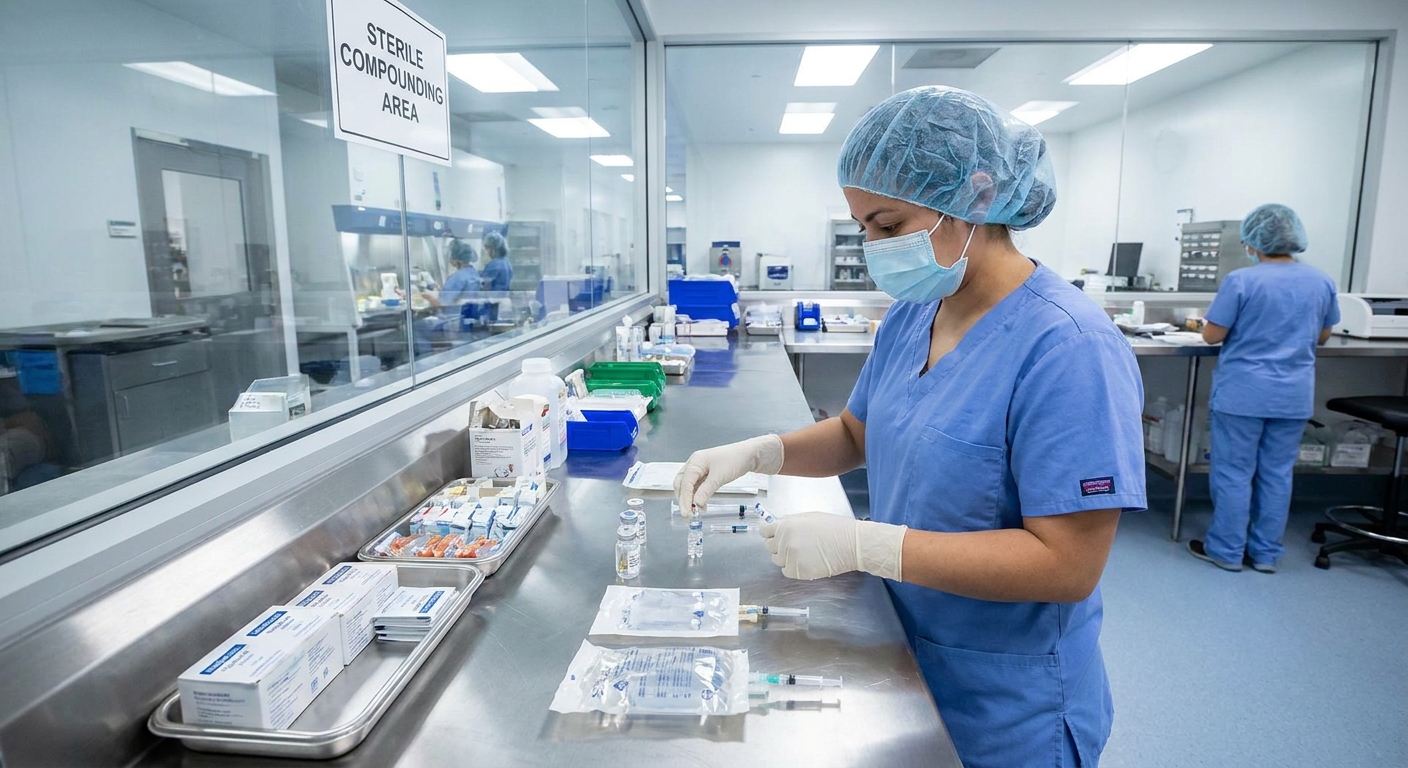
If the scenario mentions sterile garb, a cleanroom, a hood, IV additives, or anything “STAT to the unit,” it is most likely inpatient. The main exception is outpatient infusion or specialty clinics, which can borrow hospital language. On exams, though, the stem usually gives you at least one extra clue to confirm where you are.
How procedures differ and why the exam cares
Exam writers love workflow questions because they test whether you understand process, not just facts. Here are the practical differences that show up most often in questions.
Retail: accuracy, legality, and patient directions
Retail is built around a legal prescription, correct patient, correct drug, correct directions, correct quantity, correct labeling, and correct documentation. On the test, retail scenarios frequently focus on:
- Label interpretation: sig codes, day supply, refills, prescriber information.
- Calculations tied to directions: quantities for “take 1 tab twice daily for 10 days,” or mL needed for a pediatric antibiotic.
- Controlled substances rules: counts, partial fills, documentation basics.
- Medication safety at the counter: look-alike/sound-alike (LASA), allergy flags, interactions.
Hospital: sterile technique, timing, and patient-specific dosing
Hospital pharmacy is built around medication orders, patient status, administration schedules, and sterile product safety. On the exam, hospital scenarios frequently focus on:
- Order processing basics: STAT vs routine, first-dose timing, missing dose requests.
- Sterile compounding math: concentrations, dilutions, and electrolyte calculations (especially mEq, and sometimes mmol depending on the exam).
- Beyond-use dates and storage: what can be used when, and under what conditions.
- High-alert meds: extra verification steps and error prevention.
Same medication, different “most important step.” Retail is often “label and directions.” Hospital is often “sterile safety and correct concentration for a specific patient.”
Dispensing questions: tackle retail and outpatient scenarios
When the question is clearly outpatient, I recommend a consistent mental checklist. It keeps you from missing the easy points.
The retail dispensing checklist
- Confirm what is being dispensed: drug name, strength, dosage form.
- Translate the sig: make it plain English, then confirm frequency and duration.
- Compute quantity and day supply: especially for test questions that hide the “10 days” in the directions.
- Label requirements: patient name, Rx number, prescriber, directions, pharmacy info, and a use-by date per pharmacy policy (often not the bottle’s manufacturer date).
- Aux labels and storage: “shake well,” “refrigerate,” “may cause drowsiness,” “finish all medication,” and route-specific cautions.
- Final safety check mindset: right patient, right drug, right strength, right directions, allergies.
Common outpatient trap patterns
- mL vs tsp: if a question uses teaspoons, convert to mL (and watch for per-dose vs per-day).
- Insulin and devices: days supply depends on total units in the pen or vial and the prescribed daily units.
- Drops and inhalers: days supply is often about actuations or drops per mL, not just “one bottle.”
- Refill timing: the math is often straightforward, but the question is really checking if you can identify “too soon.”
If calculations are your weak spot, keep your foundation tight with pharmacy math and conversions before you drill scenario questions.

Compounding questions: tackle hospital and inpatient scenarios
Hospital compounding questions can look intimidating because they include more numbers. The trick is to slow down and identify which number represents what.
Inpatient sterile compounding: the three numbers you must label
Nearly every IV math problem includes three key pieces:
- Ordered dose: what the provider wants the patient to receive (mg, g, units, mEq).
- Stock concentration: what you have available (mg/mL, units/mL, g/50 mL).
- Final volume or diluent: what the medication ends up in (a syringe volume, an IV bag size, or an IVPB volume).
My habit: I write O, S, and F on scratch paper (Ordered, Stock, Final) and plug the numbers under the correct letter before I calculate. It prevents the classic mistake of using the bag volume as the concentration.
High-frequency inpatient math types
- Volume to withdraw: “How many mL are needed from a vial of 50 mg/mL to make a 250 mg dose?”
- Final concentration: “X mg in Y mL equals what mg/mL?”
- IV flow rates: mL/hr problems and, less commonly, gtt/min depending on what the exam includes.
- Electrolytes: mEq calculations and dilution language.
Sterile compounding rules that show up as best-answer questions
Not every hospital question is math. Many are safety and process questions. Expect themes like:
- Aseptic technique: proper garbing, disinfecting vial stoppers, working within the hood correctly.
- Risk reduction: identifying contamination risks and what to do when sterility is compromised.
- Dating and storage: recognizing that compounded sterile products use beyond-use dating (BUD). BUD is not the same thing as a manufacturer expiration date, and it is different from facility “in-use” dating policies for opened manufacturer containers.
Because standards change over time, I recommend studying sterile compounding concepts from your exam-prep materials and program notes, then using official exam outlines to confirm what is fair game for your test date. For PTCB candidates, the official content outline is here: https://www.ptcb.org/guidebook/ptce-content-outline.
If you want a simple safety anchor, it helps to know the names of the big compounding buckets. Nonsterile compounding is commonly taught under USP <795> concepts, sterile compounding under USP <797>, and hazardous handling under USP <800>. You do not need to become a standards expert for entry-level exams, but you do need the language.

When the exam mixes settings on purpose
Some questions are designed to make you assume retail when it is actually inpatient, or vice versa. Here are a few mix-up moments I see a lot in practice tests.
Dispensing does not always mean retail
Inpatient pharmacies “dispense” too, but it may mean:
- filling a patient-specific cassette of unit doses
- restocking an automated dispensing cabinet per procedure
- sending a first dose to the unit
Label can mean different things
Retail labels are patient-facing directions. Hospital labels are often administration-focused: concentration, total volume, route, infusion rate, barcodes, and internal tracking. They may also include facility-specific warnings meant for nursing workflow.
Nonsterile compounding can be either setting
Both settings can compound nonsterile products, but the context differs:
- Retail: creams, ointments, solutions, reconstitutions, flavored suspensions.
- Hospital: oral liquids for feeding tubes, topical mixtures for inpatient use, sometimes batch preps.
Gray areas that borrow from both worlds
Real life is not always a clean retail-versus-hospital split. Long-term care, mail order, outpatient hospital pharmacies, and infusion centers can blend cues. If you see a mix, do not panic. Go back to the question stem and ask, “Who is the end user, and what is the immediate task?” That usually reveals the test-writer’s intent.
If a question mentions a cleanroom hood, sterile garb, IVs, or TPN, you are probably in inpatient territory. If it mentions counseling, refills, insurance, or patient pickup, you are probably in retail territory.
A simple two-track study plan
Most students lean toward whichever environment they have seen in real life. That is normal. The fix is to study in two tracks on purpose.
Track A: Outpatient mastery
- Practice 10 to 15 label and sig interpretation questions at a time.
- Drill day supply and quantity calculations weekly.
- Memorize common outpatient high-frequency meds by class and purpose.
Track B: Inpatient mastery
- Practice concentration and dilution questions with scratch-paper labeling (O, S, F).
- Review aseptic technique concepts and sterile workflow steps.
- Spend time on hospital-heavy medication categories (anticoagulants, antibiotics, pain and sedation, electrolytes).
If you need a structured way to organize your materials, start with how to organize pharmacy tech exam study sources, then layer in your practice sets.
Quick practice: what setting is this?
Use these as mini warmups. Your job is not to answer a full question, just to identify the likely setting and what that implies.
- “IVPB vancomycin is due at 1400 and the unit requests it STAT.” Most likely inpatient. Think timing, IV preparation, concentration, sterile handling.
- “Patient requests an early refill because they are traveling.” Retail. Think day supply, refill timing, insurance limits, pharmacist involvement.
- “Prepare 250 mL of a 2% solution from stock.” Could be either, but compounding language points to nonsterile compounding math.
- “Restock the automated dispensing cabinet on the ICU.” Inpatient. Think unit inventory, barcoding, counts and documentation per policy.
- “Reconstitute amoxicillin suspension and counsel on storage.” Retail. Think final volume, shake well, refrigeration if required, discard timeframe per product labeling.
Common test-day mistakes
Mistake 1: You start calculating before you know what the question is asking
Fix: Identify setting, then underline the target: “final concentration,” “mL to withdraw,” “day supply,” or “next step.”
Mistake 2: You treat manufacturer expiration and BUD as the same thing
Fix: Remember the exam often separates these concepts. Expiration is manufacturer dating. BUD applies to compounded preparations (and sometimes repackaged items) and is assigned based on standards and conditions.
Mistake 3: You miss the unit
Fix: Circle units in the stem and answers (mg, mL, mg/mL, mEq, units). Many wrong answers are the right number with the wrong unit.
Mistake 4: You over-rely on what you see at your job
Fix: Balance your prep. If you work retail, schedule hospital math and workflow practice. If you work hospital, schedule label and day supply practice.
Where to go next
If you are still deciding which exam you are taking or what the test emphasizes, read PTCB vs ExCPT: which pharmacy technician exam should you take? and then ground your studying in the official outline for your exam.
For day-to-day structure, I also keep a broader overview of what to expect here: Pharmacy tech exam guide. Once you can quickly spot retail vs hospital cues, a lot of “tricky” questions stop feeling tricky. They start feeling like the same skills, just in two different rooms.