


After more than a decade at the front counter in high-volume community pharmacies, I can tell you this: most pharmacy technician interviews are not trying to trick you. They are trying to answer a few practical questions fast. Can you learn quickly? Can you stay accurate when it gets chaotic? Can you communicate clearly with patients, pharmacists, and insurance? And can we trust you with controlled substances and protected health information?
This guide walks through 15 of the most common pharmacy technician interview questions I have seen (and helped new hires prepare for), plus the strategy behind each one and a sample answer you can tailor to your own experience.
If you want a broader interview framework first, see my guide: Job Interview Tips.
Before you practice: a 20-second answer structure
When you get a behavioral question, use a simple structure so you do not ramble:
- Situation: Where were you working and what was happening?
- Task: What did you need to accomplish?
- Action: What did you do, step by step?
- Result: What improved or what did you learn?
For technical questions, use this structure instead:
- Safety first: Mention accuracy, verification, and when you escalate to the pharmacist.
- Process: Show that you follow a repeatable workflow.
- Documentation: Note what you record, scan, or log (per policy).
One more tip from the trenches: if you are ever unsure in an interview, it is better to say, “I would double-check the policy and confirm with the pharmacist,” than to guess confidently. Pharmacies hire for safe judgment.
Top 15 pharmacy technician interview questions
Questions 1 to 3 are usually about fit and communication. After that, most interviews ramp into workflow and safety. That is a good sign. It means they can picture you in the role and they are checking whether you will be safe under pressure.
1) “Tell me about yourself.”
What they are listening for: A quick, job-relevant summary, not your full life story.
How to answer: Present, past, then why this role.
Example answer: “Right now I am working in a customer-facing retail role where accuracy and pace matter. In the past I have handled high call volume, cash handling, inventory tasks, and detailed data entry, and I am comfortable working under tight deadlines. I am applying because I want to move into pharmacy technician work where accuracy and patient safety are the priority, and I am ready to follow workflow closely and be coached.”
2) “Why do you want to work as a pharmacy technician?”
What they are listening for: Motivation that matches the job reality (repetition, accuracy, service, pressure).
How to answer: Tie your interests to the daily work, not just “I like healthcare.”
Example answer: “I like work that rewards consistency. Pharmacy is structured, but it also requires good communication and calm problem-solving. I enjoy helping people understand what they need to do next, and I am comfortable with repetitive accuracy tasks like counting, labeling, and processing refills. That combination is what draws me to the technician role.”
3) “What do you know about our pharmacy or company?”
What they are listening for: Basic preparation and role fit.
How to answer: Mention services, patient population, hours, and why your strengths match.
Example answer: “I saw that this location has extended hours and offers immunizations, and it looks like you serve a busy mix of walk-in patients and regular refill customers. I also noticed you have drive-thru pickup, so I am expecting a fast pace and lots of quick problem-solving. I do well with structured workflows and staying steady when the line builds, so I think I would fit this environment.”
4) “Walk me through how you would process a prescription.”
What they are listening for: A safe workflow and clear boundaries between tech and pharmacist tasks.
How to answer: Speak in steps and include safety checks. Use language that shows you know when to escalate.
Example answer: “First I would confirm the prescription has the required elements and is readable, and that I am working in the correct patient profile. I would enter the prescription carefully, checking the drug name, strength, dosage form, directions, quantity, refills, and prescriber details. If anything is unclear or looks outside normal expectations, I would stop and flag it for the pharmacist. Then I would generate labels, pull the stock bottle, verify the drug and strength match, check the NDC and expiration date when required by policy, and count or measure using the correct equipment. I would keep it staged for pharmacist verification and final check. After the pharmacist signs off, I would complete pickup steps, verify the patient identity, and collect any required signatures or logs per state law and store policy.”
If SIG codes and abbreviations make you nervous, practice them ahead of time here: Pharmacy SIG Codes and Medical Abbreviations.
5) “How do you handle a high-stress, high-volume shift?”
What they are listening for: Prioritization, teamwork, and staying accurate.
How to answer: Describe your triage method and how you communicate.
Example answer: “I focus on doing fewer things at once, but doing them correctly. I prioritize time-sensitive items first, like waiters, critical calls from prescribers, and issues that block the workflow. I communicate clearly, for example, letting the pharmacist know I have an insurance rejection that needs a decision. And when the line builds, I keep my tone calm and set expectations with patients on realistic wait times.”
6) “Tell me about a time you made a mistake at work. What did you do?”
What they are listening for: Honesty, accountability, and process improvement.
How to answer: Choose a real, non-catastrophic example and show the fix.
Example answer: “At a previous job I entered an item under the wrong customer profile because two names were similar. I caught it during the confirmation step, stopped the transaction, corrected the profile, and told my supervisor. After that, I made it a habit to verify date of birth every time before finalizing. It slowed me down by a few seconds, but it prevented repeats.”
7) “How do you ensure accuracy when counting and labeling?”
What they are listening for: You respect the risk and follow a repeatable system.
How to answer: Mention checks: drug, strength, expiration, and distractions.
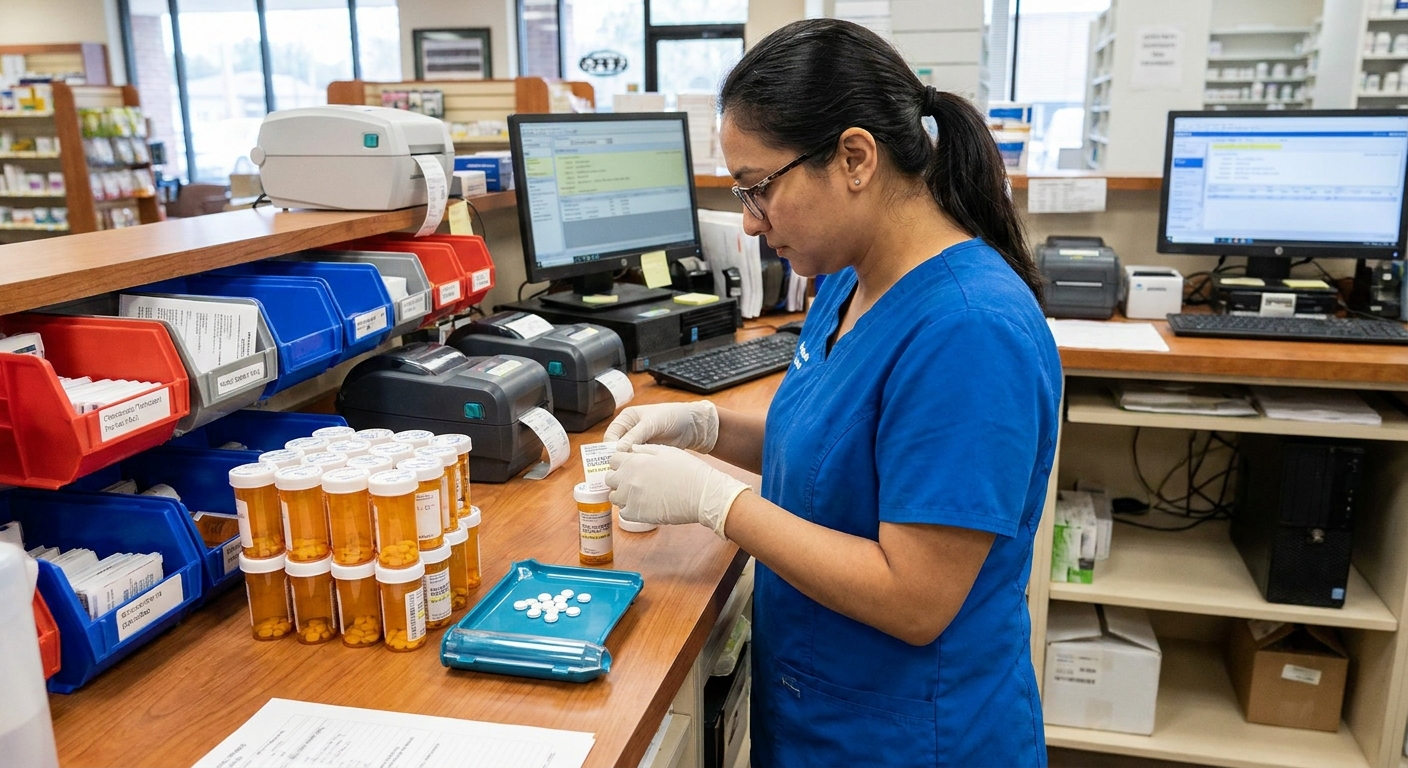
Example answer: “I follow the same sequence every time: match the label to the stock bottle, verify the drug and strength, check the NDC when required by policy, and confirm the expiration date. I count using a clean tray and spatula, and I keep the bottle and label together until the task is done so nothing gets mixed. If I get interrupted, I restart the check rather than guessing where I left off.”
8) “How comfortable are you with pharmacy math?”
What they are listening for: Competence plus willingness to double-check.
How to answer: Be specific about what you can do and how you verify.
Example answer: “I am comfortable with day supply, quantities, basic conversions, and calculating how long a prescription should last based on directions. I also know when to pause and verify, especially with concentrations and liquid measurements. When I am unsure, I re-check the units and confirm with the pharmacist to avoid errors.”
Want a refresher that is built for interview and exam confidence? Study here: Pharmacy Math and Conversions.
9) “What would you do if a patient is angry about a long wait?”
What they are listening for: De-escalation and protecting the team’s workflow.
How to answer: Acknowledge, set expectations, offer options, avoid blame.
Example answer: “I would stay calm and acknowledge the frustration: ‘I understand you have been waiting.’ Then I would check the actual status of the prescription, give a realistic time estimate, and offer options like coming back later or speaking with the pharmacist if it is a clinical concern. I avoid blaming coworkers and I do not promise a time I cannot meet.”
10) “How do you handle confidential information?”
What they are listening for: Respect for privacy and good judgment on the counter.
How to answer: Mention limiting access, verifying identity, and minimizing public discussion.
Example answer: “I treat patient information as private by default. I only access profiles for work tasks I am authorized to do, I verify identity before discussing details, and I keep conversations discreet at pickup. If someone asks for information and I am not sure they are authorized, I pause and involve the pharmacist or follow policy rather than taking chances.”
11) “Describe your experience with insurance rejections or prior authorizations.”
What they are listening for: You can work the problem and communicate clearly.
How to answer: Explain the basic troubleshooting path and escalation.
Example answer: “When a claim rejects, I first confirm the basics are entered correctly, like patient demographics and insurance details, including BIN and PCN if applicable. Then I read the rejection message carefully and take the next step, like correcting day supply, fixing a typo, or selecting a covered NDC for the same prescribed product when plan rules and pharmacy policy allow it. If the reject points to a prior authorization or a clinical decision, I gather the needed info and bring it to the pharmacist so we can contact the prescriber or advise the patient appropriately.”
12) “Retail or hospital: which environment do you prefer and why?”
What they are listening for: You understand the setting and are not guessing blindly.
How to answer: Match your strengths to the environment you are applying to.
Example answer: “I enjoy direct patient interaction and I am comfortable with the pace of retail, including multitasking and customer service. At the same time, I am interested in hospital pharmacy because the workflow is more distribution-focused and still requires high accuracy. Ultimately I want to work where training is strong and expectations are clear, and I am ready to adapt to this setting.”
If you are still deciding, compare scenarios here: Hospital vs Retail Pharmacy Scenarios.
13) “How do you prioritize tasks when everything is urgent?”
What they are listening for: A practical prioritization ladder.
How to answer: Name your top priorities and how you confirm them with the team.
Example answer: “I prioritize tasks that affect safety and workflow first: anything the pharmacist needs to verify, prescriptions for patients waiting, and calls that unblock a claim or clarify directions. Next I handle time-sensitive operational tasks like returns-to-stock and inventory issues. If I am unsure what should come first, I ask the lead tech or pharmacist for the priority order so I do not accidentally slow the team down.”
14) “How do you learn new software or a new workflow quickly?”
What they are listening for: Trainability and self-management.
How to answer: Show your method: notes, repetition, checklists, feedback.
Example answer: “I learn best by doing, so I ask for a quick demonstration, then I repeat the task while taking simple notes. I build a short checklist for common steps, and I ask for feedback early so I do not practice the wrong habit. If there is a policy manual, I review it after the shift and write down questions for the next day.”
15) “Do you have any questions for us?”
What they are listening for: Professionalism and long-term fit.
How to answer: Ask questions that reveal training, workflow, and expectations.
Good questions to ask:
- “What does success look like in the first 30 to 60 days for a new technician?”
- “How is training structured and who would I be working with most closely?”
- “How do you handle peak hours and task assignments?”
- “What is your approach to preventing errors and interruptions at fill?”
- “Are there opportunities to cross-train, for example inventory, billing, compounding, or specialty workflows?”
More questions you will probably hear
In real interviews, these come up constantly. They are not trick questions. They are “can we schedule you, trust you, and work with you” questions.
Availability and scheduling
What they are listening for: Reliability, flexibility, and realistic boundaries.
Example answer: “I can work evenings and weekends, and I understand holidays rotate in retail. I am reliable with start times, and if something comes up I communicate early so the schedule is not a surprise.”
Controlled substances and discrepancies
What they are listening for: Integrity and immediate escalation.
Example answer: “If I notice a count discrepancy or anything that does not match what the system or log says, I stop and notify the pharmacist or lead immediately. I do not try to ‘fix’ controlled substance issues on my own. I follow the documentation process and policy step by step.”
Team conflict or communication issues
What they are listening for: Professional communication under pressure.
Example answer: “I address issues directly and respectfully. If something is unclear, I ask a quick clarifying question instead of guessing. If there is a conflict, I keep it focused on the workflow and patient safety, and I involve a supervisor if it affects the shift.”
Technical topics to review
Not every interview includes technical quiz questions, but it is smart to be ready for basic prompts like, “At a high level, what is a DEA number used for?” or “What does BID mean?” Here is what I recommend reviewing the week of your interview:
- SIG basics: common abbreviations, routes, frequencies, and “prn” language (study here).
- Pharmacy math: day supply, mL conversions, insulin and inhaler quantities (study here).
- Top drugs: brand and generic recognition, therapeutic class, and common indications (Top 200 study approach).
- Law and ethics basics: privacy mindset, controlled substances awareness, and when to escalate to the pharmacist (review here).
Credentials and onboarding basics
One more thing candidates get blindsided by: hiring steps and requirements can vary a lot by state and employer. You might be asked about technician registration or licensure, a background check, drug screening, or immunization requirements for certain workplaces.
If it comes up, keep your answer simple and professional: you follow requirements, you complete paperwork promptly, and you do not cut corners. If you are unsure what applies in your state, say so and ask what their process is.
Working interview basics
Some pharmacies do a working interview or skills observation. Done correctly, it is usually about seeing how you move, communicate, and follow directions, not throwing you into production unsupervised.
- Stay in your lane: do not counsel patients, and do not make clinical judgments.
- Do not access patient profiles or PHI unless you are explicitly authorized and supervised per policy.
- Think out loud: narrate your checks, ask where the policy lives, and confirm priorities before you start a task.
Common answer mistakes
- Sounding casual about safety: Even if you are friendly, your wording should show caution and respect for the process.
- Blaming patients or coworkers: Frame problems as workflow challenges you can handle professionally.
- Overpromising speed: “Fast” is great, but “fast and accurate, with checks” is what gets you hired.
- Not knowing your limits: If you are not certified yet or have not used a system before, say so and explain how you will learn.
- Vague examples: One specific story beats five general statements.
A 3-day practice plan
Day 1: Build your stories
- Write 4 short situations you can reuse: an angry customer, a mistake you corrected, a time you learned quickly, a time you prioritized under pressure.
- Practice saying each story out loud in under 60 seconds.
Day 2: Technical refresh
- Review SIG basics and common drug names.
- Do 10 to 15 pharmacy math problems, then check your work.
- If certification comes up in your interview, it helps to know the landscape. See: PTCB vs ExCPT.
Day 3: Mock interview
- Answer the 15 questions in this article with a timer.
- Record yourself once. Listen for filler words, overly long explanations, and missing “result” lines.
- Pick 3 questions you will ask them at the end.
If your bigger goal is building a stable plan for the job and the certification path, start here: Healthcare Careers Guide.
Quick FAQ
Should I bring anything to a pharmacy technician interview?
Bring a printed resume, a short list of references if requested, and any certification or training documentation you already have. If you are scheduled for a working interview or skills assessment, bring a government ID and dress in clean, comfortable professional clothing.
Is it OK to say I do not know?
Yes, if you follow it with a safe next step. In pharmacy, “I do not know, but I will verify with the pharmacist or policy before proceeding” is a strong answer.
What if I have no pharmacy experience?
Lean into transferable skills: cash handling, accuracy, confidentiality, customer service, and working under pressure. Then show you are already studying the basics, especially math and SIG codes.
Will I need a license or registration before I start?
It depends on your state and the employer. Some places hire trainees and help you complete registration steps, while others require it up front. If you are unsure, say you are ready to meet the requirement and ask what their timeline is.