

In my first few years working the counter, I thought “compounding” meant counting capsules and maybe mixing a magic mouthwash. Then I watched a tech gown up and work inside a cleanroom like they were landing a spacecraft. That was the day I realized compounding questions on the certification exam are really testing one thing: can you keep patients safe by controlling contamination, mix-ups, and exposure?
This guide breaks USP <795> (non-sterile), USP <797> (sterile), and USP <800> (hazardous drugs) into the parts you are most likely to see on an exam: workflow, required areas and equipment, garbing, cleaning, beyond-use dating, and what to do when something goes wrong.
Quick note on “current USP”: USP <795> and USP <797> were revised with major changes taking effect in late 2023. Exams and workplaces do not always update on the same timeline. I wrote this as an exam-focused overview that emphasizes the principles and the commonly tested defaults, but your safest answer in real life is always your facility policy and state board rules.
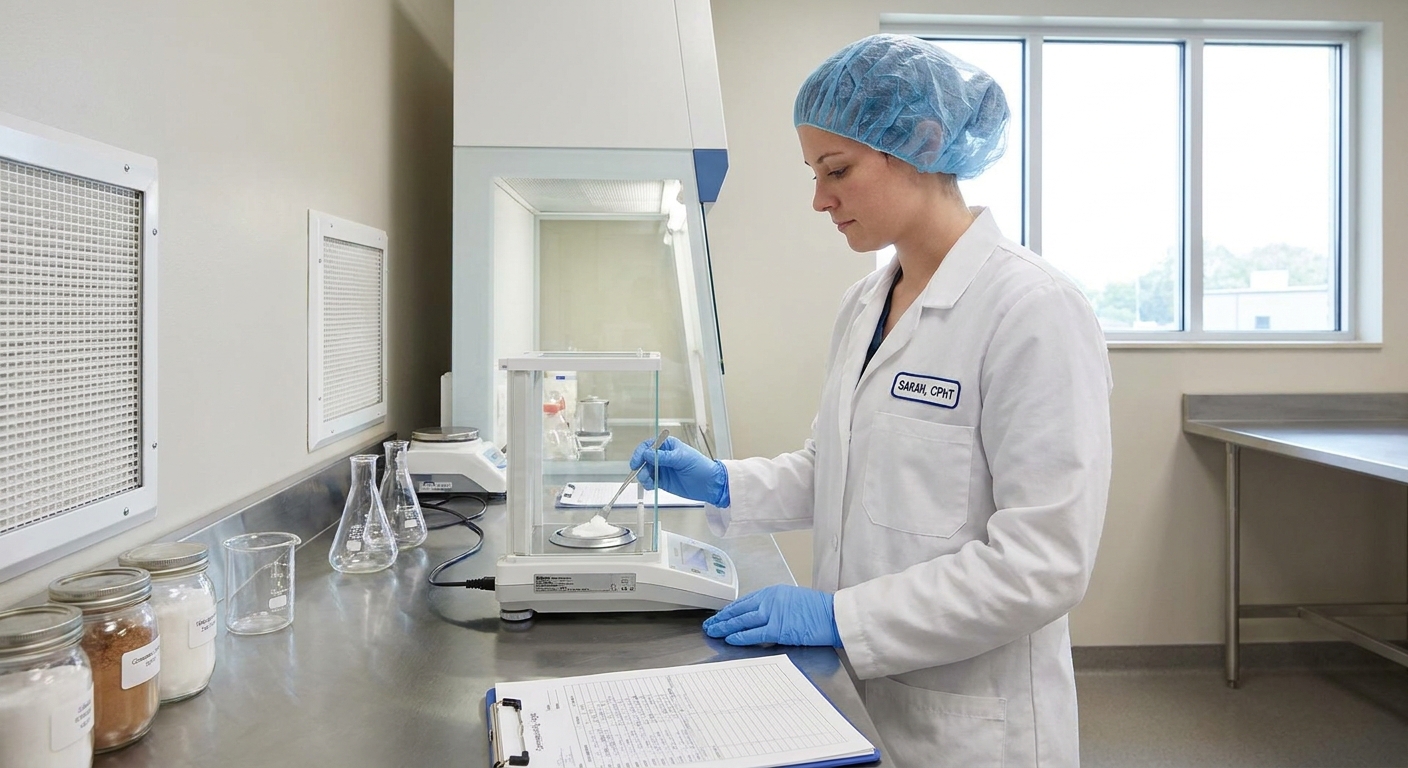
How the USP chapters fit
Think of the USP chapters like three overlapping safety nets:
- USP <795> Non-sterile compounding: creams, ointments, solutions, suspensions, capsules, troches. Focus is preventing contamination, correct calculations, accurate labeling, and appropriate beyond-use dates.
- USP <797> Sterile compounding: anything that must be sterile (IVs, TPN, ophthalmics, some injectables). Focus is aseptic technique, cleanroom behavior, air quality, and sterility assurance.
- USP <800> Hazardous drugs (HD): how to handle drugs that can harm staff (carcinogenic, teratogenic, genotoxic, organ toxicity). Applies to handling across the medication-use process, including receiving, storing, compounding, spill response, disposal, and administration in applicable settings. It covers both sterile and non-sterile when the product is hazardous.
Exam mindset: when you see a compounding question, ask: Is it sterile or non-sterile? Is it hazardous? Then pick the strictest safety rule that applies.
USP <795> essentials
What counts as non-sterile?
Non-sterile compounding is making or altering a medication that does not require sterility. Common examples include:
- Dermatologic creams and ointments
- Oral solutions and suspensions
- Capsules from bulk powders
- Suppositories
- Topical gels, shampoos, mouth rinses
Core idea: control what you can
USP <795> expects a consistent process that prevents avoidable problems:
- Ingredient selection: correct chemical form, correct strength, appropriate grade and source.
- Accurate weighing and measuring: calibrated balance, appropriate glassware, minimize transfer loss.
- Clean workspace and equipment: keep powders and residues from cross-contaminating the next preparation.
- Documentation: formulation record and compounding record.
- Labeling: clear directions, storage, BUD, and auxiliary warnings.
Equipment to recognize
- Class A prescription balance or electronic balance: used for accurate weighing.
- Mortar and pestle: trituration (grinding) and mixing powders.
- Ointment slab or parchment paper: levigation and geometric dilution.
- Graduates and syringes: measuring liquids accurately.
- Spatulas: ointment mixing and transferring.
- Capsule machine: filling capsules uniformly.
Mixing techniques that get tested
- Geometric dilution: when mixing a small amount of potent ingredient into a larger amount of base, you mix equal portions step-by-step to distribute evenly.
- Levigation: making a paste with a levigating agent to reduce particle size and improve smoothness (common in ointments and creams).
- Trituration: grinding powders in a mortar.
Non-sterile BUD: the legacy defaults
In real life, BUD assignment depends on the formulation, ingredients, stability data, packaging, and your site policy. But many certification-style questions still lean on the traditional USP <795> default BUDs when no stability information is provided.
If an exam question gives you no stability data and asks for the default BUD, these are the commonly taught legacy numbers:
- Nonaqueous formulations (no water added): up to 6 months or the earliest ingredient expiration date, whichever is earlier.
- Water-containing oral formulations: up to 14 days when stored at controlled cold temperatures, unless otherwise specified.
- Water-containing topical or mucosal formulations: up to 30 days, unless otherwise specified.
Exam trap: BUD is not the same as the manufacturer expiration date. Expiration is for the original manufactured product in its original container. BUD is for what happens after you manipulate it.
If you want to sharpen the math side (because BUD questions sometimes hide a calculation), pair this guide with Pharmacy Math and Conversions.
When you should not compound
On the job and on the exam, there are moments where the safest move is to pause and escalate. Red flags include:
- No reliable formula, missing key instructions, or a calculation you cannot verify.
- Questionable stability or incompatibility with no supporting data and no approved reference.
- Allergy or sensitivity concerns you cannot resolve (for example, base ingredients, dyes, preservatives).
- No appropriate area, equipment, or PPE for the preparation, especially if cross-contamination is a risk.
- Ingredient identity is uncertain, expired, or sourced improperly per policy.
Labeling and packaging cues that show up in questions
- Route warnings: “For external use only” is a classic for topicals.
- Shake warnings: suspensions often need “Shake well.”
- Storage: “Refrigerate” or “Protect from light” when indicated.
- BUD and storage together: if the label says refrigerate, your BUD and patient instructions must match that reality.
Documentation details techs get quizzed on
- Record ingredients, amounts, and calculations.
- Capture lot numbers and expiration dates of ingredients when required by policy.
- Note who compounded and who verified (common workflow question).
USP <797> essentials
Sterile compounding is a different universe because the final product is going into a place the body cannot easily defend, like the bloodstream or the eye. The exam typically tests whether you understand:
- How sterile products are protected from contamination
- How people contaminate sterile products (touch, airflow disruption, poor garbing)
- Why cleanroom design and behavior rules exist
Critical sites: know this cold
When exam writers say critical sites, they mean sterile parts that must stay sterile because they directly contact the sterile fluid pathway or the final sterile product. Common examples include syringe tips, needle hubs, vial septum puncture sites after disinfection, spikes, and open ports.
Airflow and first air
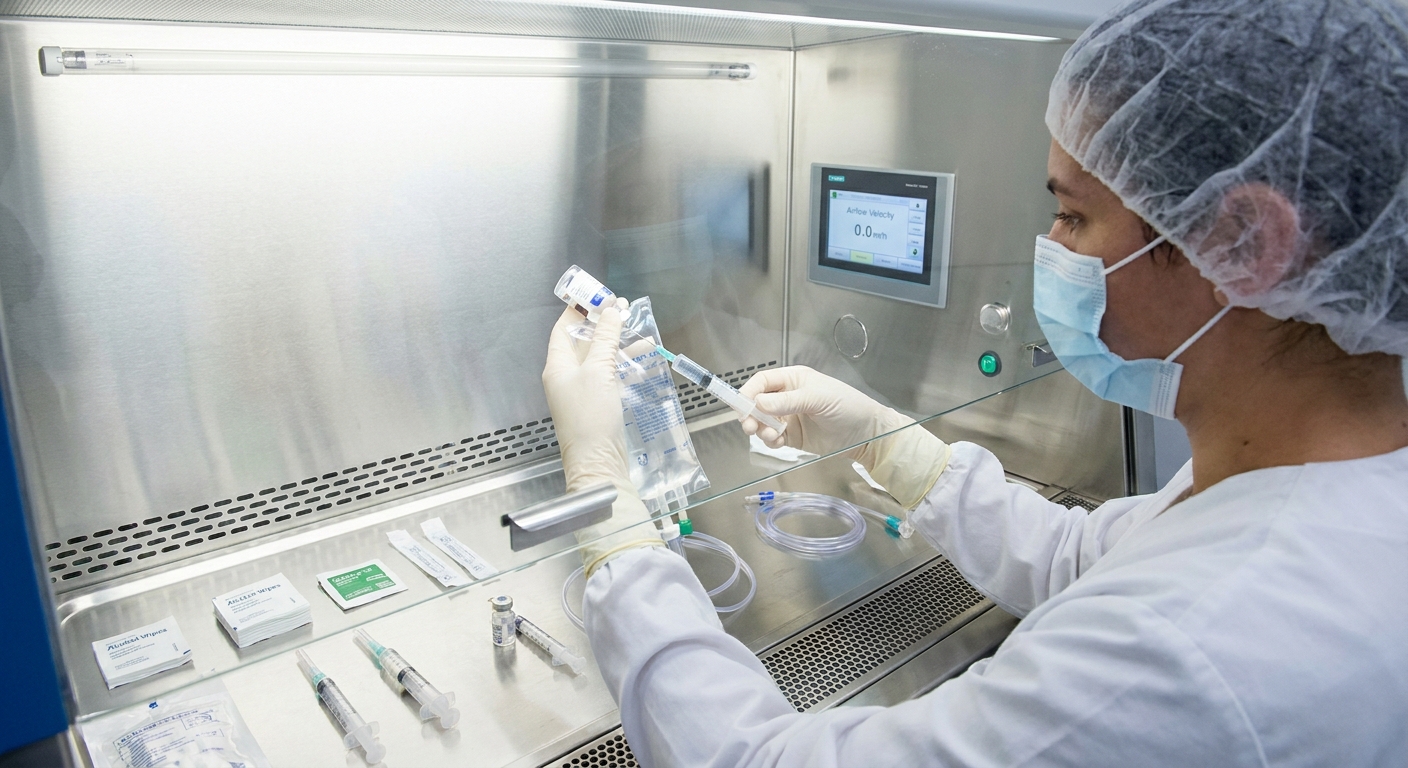
Here is the mental model I teach new staff: HEPA-filtered air moves in a unidirectional stream out of the filter and across the compounding work zone. Your job is to keep critical sites downstream of the filter in clean airflow, and never block that airflow with your hands, supplies, or wrappers.
- PEC (Primary Engineering Control): where sterile compounding happens. Examples: laminar airflow workbench (LAFW), biological safety cabinet (BSC), compounding aseptic containment isolator (CACI) for hazardous sterile work.
- ISO classifications: lower number means cleaner air. Exam questions often reference ISO 5 at the work area (PEC) and cleaner-to-dirtier room concepts.
- Device reminder: airflow direction depends on the device (for example, horizontal vs vertical flow). The testable rule stays the same: do not obstruct first air to critical sites.
Garbing and hand hygiene
Garbing questions love ordering and common-sense contamination points. The principle is always: cover the high-shed areas first, then do your cleanest steps last. Exact sequences vary by facility and updates over time.
One common sequence you will see in training and exam-style material looks like this:
- Hair cover and beard cover (if applicable)
- Shoe covers or dedicated cleanroom footwear (site dependent)
- Face mask
- Hand and forearm hygiene (thorough wash)
- Non-shedding gown (sterile for some processes)
- Sterile gloves (often with glove sanitization using sterile alcohol inside the PEC)
Aseptic technique: what exam writers test
- Disinfect vial stoppers and ampule necks with sterile alcohol (commonly sterile 70% IPA) per policy and allow it to dry.
- Maintain first air: keep critical sites in clean airflow, and do not reach over open containers or syringe tips.
- Do not touch critical parts: needle, syringe tip, vial septum at the puncture site after disinfection, spike, ports. If you contaminate it, replace it.
- Minimize talking and unnecessary movement: people are particle generators.
Placement inside the hood
Some exams still use simplified rules like “keep work well inside the PEC.” Device design and site policy matter, so think in principles:
- Keep supplies well inside the ISO 5 area and away from the front edge where turbulence is more likely.
- Avoid crowding. Crowding increases turbulence.
- Do not put wrappers, labels, or hands between the HEPA filter and critical sites.
Cleaning vs disinfecting
You might see questions that separate:
- Cleaning (removing residue and dirt) versus disinfecting (killing microbes).
- Routine surface disinfection inside the PEC versus broader cleanroom cleaning schedules.
If aseptic technique breaks
Exams love this because the safest action is almost never “just keep going.” If you suspect contamination:
- Stop and protect the product from further exposure.
- Replace the contaminated component (or remake the preparation if sterility is uncertain).
- Disinfect as required and re-establish clean workflow.
- Document and notify the pharmacist per policy.
Sterile BUD: what to remember
Sterile BUD can be complex in the real world because it depends on environment, process controls, sterility testing, and product-specific stability. The sterile BUD framework has also evolved in recent USP revisions. For exam purposes, focus on what drives a shorter BUD:
- Compounded outside of a controlled cleanroom environment
- More manipulation, more entries into containers, more components
- Any break in aseptic technique or uncertain sterility
If sterile technique questions make you nervous, practice scenario-style questions. That is exactly why I put together Use Practice Tests to Find Your Pharmacy Tech Weak Spots.
USP <800> essentials
USP <800> is the chapter that protects you, your coworkers, and anyone who shares your air or trash stream. If a drug is hazardous, the workflow changes.
What makes a drug hazardous?
Hazardous drugs are those with the potential to cause harm with occupational exposure (for example, many antineoplastics). In practice, facilities typically base their lists on sources like NIOSH and then build policies around the specific products they handle.
Common handling touchpoints
USP <800> is not just about mixing chemo. Test questions often show hazardous exposure risk in everyday tasks like:
- Receiving and unpacking HD shipments
- Storing HDs (segregation and labeling per policy)
- Counting or packaging tablets and capsules that are on the HD list
- Crushing, splitting, or opening capsules (higher exposure risk)
- Cleaning up residue on trays, counters, and equipment
Key behaviors that get tested
- Use appropriate PPE: chemotherapy-tested gloves, gowns, eye and face protection if splash risk, and sometimes respiratory protection depending on the task.
- Containment strategies: hazardous sterile compounding typically requires containment devices (like certain BSCs or isolators) and room pressure concepts.
- Separate handling: receiving, unpacking, and storage may be segregated to reduce spread of residue.
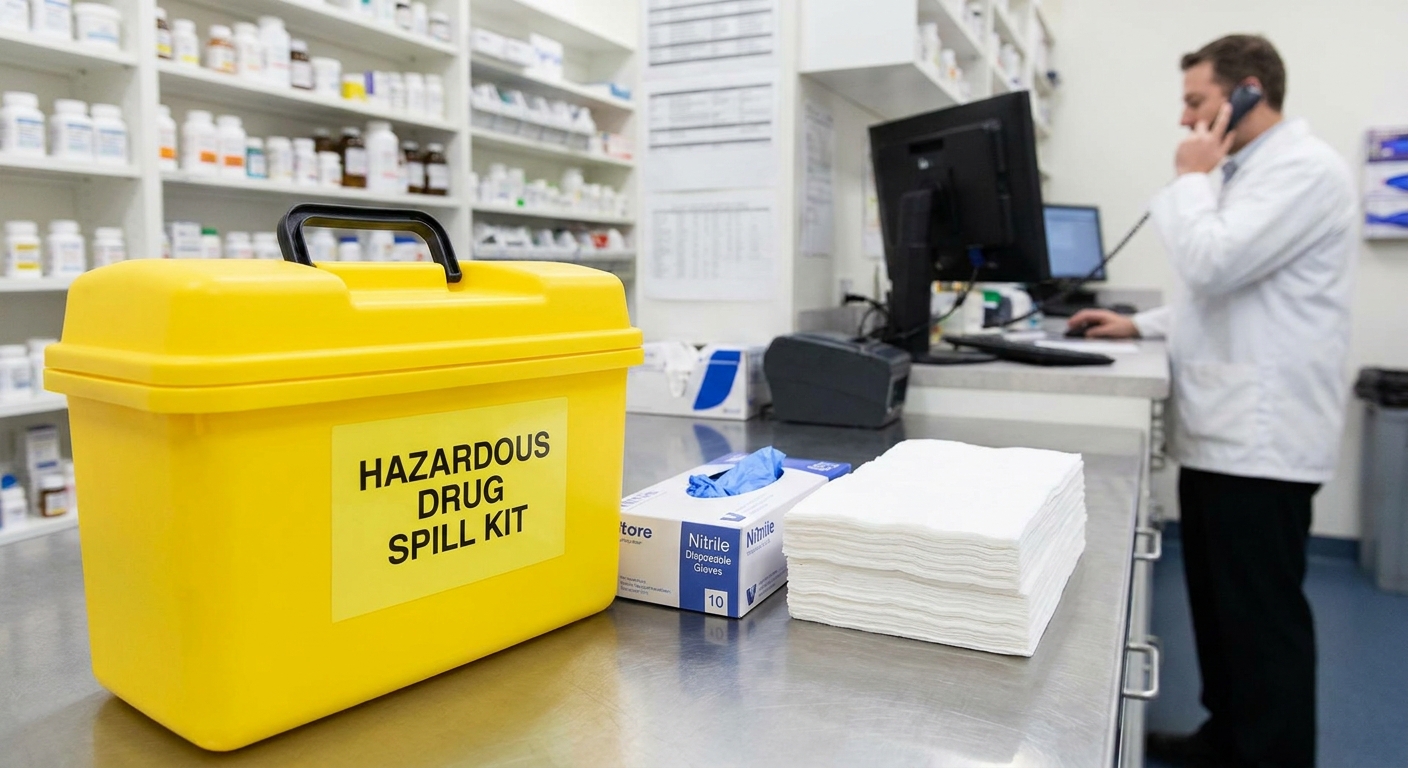
- Spill management: know that spill kits exist for a reason and that the response includes PPE, containment, cleanup, and proper disposal.
- Waste disposal: hazardous waste goes into the correct waste stream, not regular trash.
The crossover rule
A lot of test-takers miss this: USP <800> applies to hazardous drugs even if the preparation is non-sterile. A hazardous topical cream is still hazardous. So the chapter you follow is not either-or. It stacks.
For exam questions, you usually do not need to memorize the entire hazardous drug list. If the question identifies a medication as hazardous, treat it as hazardous and switch to USP <800> handling: PPE, containment, careful cleanup, and correct disposal. It also helps to remember the common buckets that show up in test questions, like chemotherapy agents, and some antivirals and hormones that appear on the NIOSH hazardous drug list.
Quick compare
| Topic | USP <795> (Non-sterile) | USP <797> (Sterile) | USP <800> (Hazardous) |
|---|---|---|---|
| Main risk being controlled | Contamination, incorrect strength, instability | Microbial contamination, endotoxins, particulates | Staff exposure and environmental contamination |
| Typical examples | Creams, suspensions, capsules | IV admixtures, TPN, ophthalmics | Chemo and other HDs per list |
| Environment focus | Clean designated compounding area | Cleanroom and ISO-classified air at PEC | Containment areas, pressure controls, dedicated processes |
| PPE focus | Basic PPE as appropriate | Garbing, sterile gloves, aseptic behaviors | Chemo-tested gloves and gown, spill protection, disposal controls |
| Big exam trap | Confusing BUD with expiration date | Blocking airflow or touching critical sites | Forgetting USP <800> also applies to non-sterile HD handling |
Common exam scenarios
Scenario 1: Supplies in the hood
What they test: airflow and first air.
- Keep critical sites in uninterrupted clean airflow.
- Do not crowd the work area. Crowding increases turbulence.
- Avoid placing hands, wrappers, or labels between the filter and sterile parts.
Scenario 2: Gloved hand touches syringe tip
What they test: critical sites cannot be contaminated and then ignored.
- The safe answer is to discard or replace the contaminated component and continue with new sterile supplies, following policy.
Scenario 3: Compounded oral liquid has water
What they test: water increases microbial risk and often shortens BUD.
- If the question uses default non-sterile BUD logic, water-containing oral liquids commonly point you toward 14 days refrigerated unless stability data says otherwise.
Scenario 4: Drug is hazardous but not injectable
What they test: USP <800> still applies.
- Use the PPE and containment expectations for hazardous handling, even for non-sterile dosage forms.
Scenario 5: Chemo spill response
What they test: you do not improvise.
- Use the spill kit and required PPE, limit spread, dispose correctly, and follow workplace procedure.
Study checklist
Memorize
- Which chapter is non-sterile (USP <795>), sterile (USP <797>), hazardous drugs (USP <800>)
- Definitions of BUD vs expiration date
- Legacy non-sterile default BUDs: 6 months (nonaqueous), 14 days (water-containing oral, refrigerated), 30 days (water-containing topical/mucosal)
- Terms: aseptic technique, first air, geometric dilution, levigation, trituration
- What counts as a critical site (syringe tip, needle hub, vial septum puncture site after disinfection, ports)
Understand
- How airflow gets blocked and why it matters
- Why garbing is sequenced and what steps reduce shedding
- How hazardous rules stack on top of sterile or non-sterile rules
- How to pick the safest action when contamination is suspected (replace, remake, document)
Need a broader plan for organizing this with the rest of your exam topics? Start with Study Guides and then build a weekly plan using Organise Your Pharmacy Tech Exam Study Sources.
Quick FAQ
Will the exam ask me to quote USP rules?
Most certification-style questions are written to test safe practice and understanding, not your ability to recite USP text. Know the chapter purpose and apply the safety logic. When an exam item uses a default, it is usually pointing you toward commonly taught baseline rules.
Do I need to memorize ISO numbers?
You should recognize that ISO 5 is associated with the primary compounding area where critical sites must be protected. Beyond that, many exams focus more on behavior and workflow than exact room specs.
Biggest sterile compounding mistake?
Blocking first air or contaminating a critical site and continuing anyway. When in doubt, replace the contaminated component and protect the patient.
Biggest hazardous drug mistake?
Handling a hazardous drug like it is “just another medication.” USP <800> exists because tiny exposures add up, so PPE, containment, and disposal rules matter.
Optional references
For exam prep, your best move is to use these as background, then practice applying concepts with questions and scenarios.