

When I was training new techs at a busy community pharmacy, I noticed the same pattern every recert cycle: the smartest people in the room would suddenly get stressed, not because CE was hard, but because it felt scattered. A credit here, a login there, a deadline you meant to write down. The work itself was manageable. The tracking was the trap.
This guide is the system I wish everyone had from day one: how CE works for PTCB and ExCPT, what subject matter typically trips people up, how to avoid paying for the wrong thing, and how to keep proof in a way that survives job changes, password resets, and life.

First, confirm which certification you are maintaining
Pharmacy technician continuing education is not one universal set of rules. Your CE requirements depend on the credential you hold.
- PTCB (CPhT certification)
- ExCPT (NHA’s pharmacy technician certification)
If you are still deciding which exam to take or which credential your employer prefers, start here: PTCB vs ExCPT: which pharmacy technician exam should you take?
My practical rule: do not buy or start CE until you have confirmed which credential you are renewing and the exact renewal window. One wrong assumption can turn into wasted hours that do not count.
National CE vs state or employer rules
This article is about maintaining your national certification (PTCB or ExCPT). Your state board of pharmacy and your employer may have additional requirements (or separate training) on top of that. It is completely normal for technicians to be juggling more than one “set of rules,” so be clear about which bucket each course belongs in before you spend time on it.
How CE is usually structured (and what counts)
Most CE requirements come down to four questions:
- How many total hours you need in your renewal cycle
- Which topics are mandatory (often things like pharmacy law and patient or medication safety, depending on the credential and current rules)
- Whether hours must be technician-specific or within a category
- Whether the provider and activity type are accepted by your certifying body (in other words, recognized or accredited in a way your credential accepts)
Quick reality check: requirements can change. At the time of writing, PTCB commonly has specific required hours in areas like pharmacy law and patient safety, but you should confirm the exact categories and labels in your account dashboard for your current cycle.
Because details can change over time, I recommend verifying your current requirements directly with your certifying organization before you plan your cycle:
Even if you do nothing else today, do this: write down your renewal deadline and your required topic areas. Those two notes prevent most last-minute CE panic.
The CE topics that catch technicians off guard
In my experience, most technicians do not struggle with learning. They struggle with category rules. Here are the common gotchas to watch for.
1) Law and regulations
People often assume employer training counts automatically. Usually, it does not. For national recertification, employer training only counts if it is offered as an accepted, accredited CE activity and it produces the kind of documentation your credential requires.
If law is a weak spot, review the foundations alongside your CE: Pharmacy law and ethics: what you must know to pass.
2) Patient safety and medication error prevention
Patient safety CEs often sound repetitive until you connect them to real workflow: look-alike sound-alike drugs, high-alert meds, barcode scanning workarounds, interruptions at the register, and data entry habits.
Tip: choose safety CEs that match your setting (retail, hospital, long-term care) so the examples stick.
3) Technician-specific requirements
Some CE must be designated specifically for pharmacy technicians, not just healthcare in general. A great general pharmacology course might still be rejected if it is not categorized correctly.
Where to check: look in the course listing and on the completion certificate for the intended audience or activity type (for example, language that clearly indicates it is for pharmacy technicians).
4) Live vs on-demand formats
For national recertification, many technicians complete CE through on-demand courses without any issues. Format rules, if they exist, tend to show up more in state licensing or employer programs, not because someone prefers one format over another.
Do not assume. Verify early, then plan around your schedule.
How to choose CE that will actually be accepted
When you are shopping for CE, you are really shopping for documentation. A good CE activity should make it easy to prove:
- Who provided it
- What the topic was
- How many hours it was worth
- When you completed it
- Any ID numbers or accreditation identifiers required for reporting
A simple pre-purchase checklist
- Matches your credential’s topic rules (law, patient safety, technician-specific, and so on)
- Matches your renewal cycle dates (completed within the correct window)
- Provides a completion certificate you can save
- Clear refund or retake policy in case you fail the post-test
What to look for on the certificate
- Your name (or your unique ID, depending on the system)
- Course title
- Provider name
- Date of completion
- Number of hours
- Accreditation or activity identifiers (whatever your credential uses to recognize the activity)
If you are building your overall study and career plan, my broader organizing approach is here: Organise pharmacy tech exam study sources. The same one-system mindset works for CE.
My tracking system (low stress, works even if you change jobs)
I like systems that survive real life. This one works with nothing more than a notes app and a single folder.
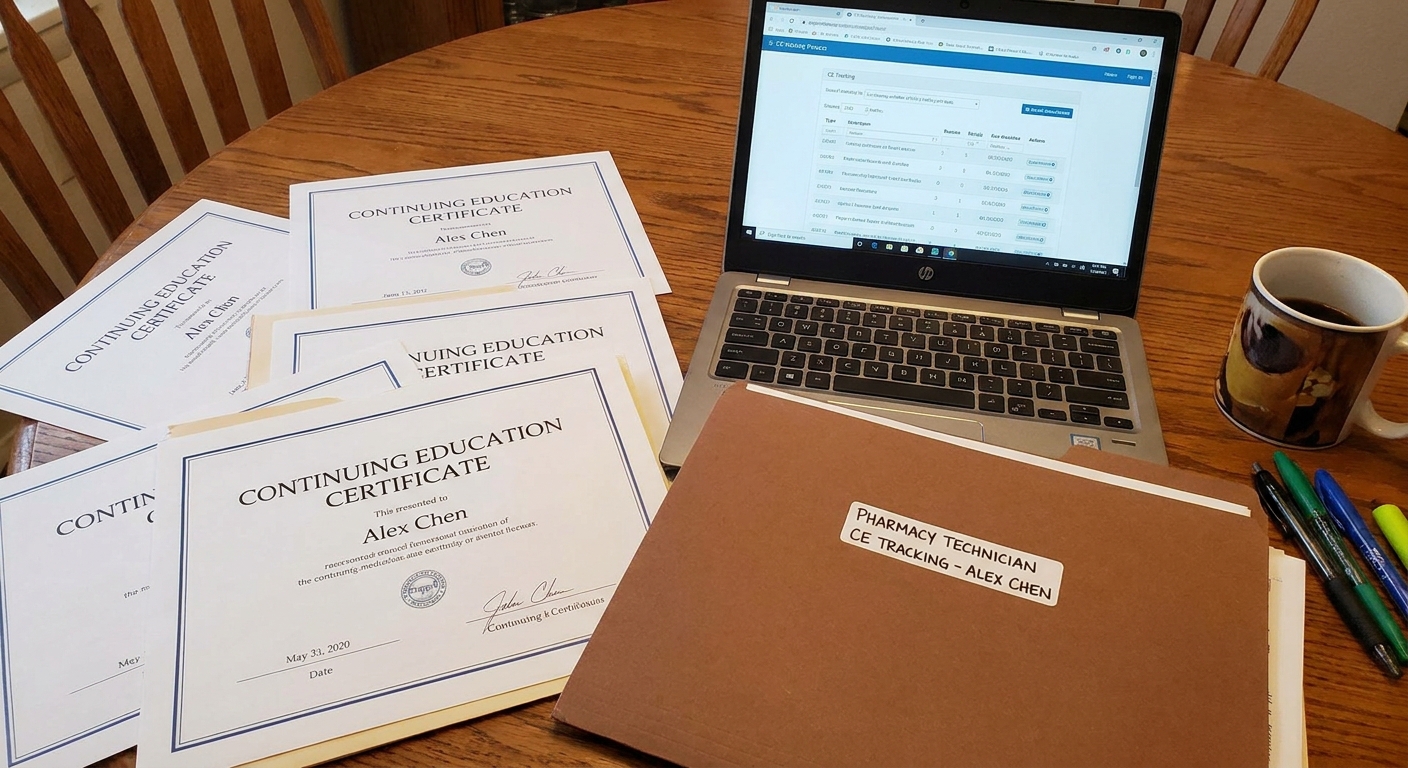
Step 1: Make one CE folder
Create a folder called something like:
- Pharmacy Tech CE
- CE 2026-2028 (or your cycle years)
Inside it, keep:
- Certificates of completion
- Receipts (if paid)
- Course descriptions or confirmations (helpful if a title is vague)
Step 2: Keep one running log
Use a simple spreadsheet or note with these columns:
- Date completed
- Course title
- Provider
- Hours earned
- Category (law, patient safety, technician-specific, general)
- Proof saved? (yes/no)
Step 3: Schedule two CE check-ins per cycle
Most people try to do CE all at once at the end. I prefer two checkpoints:
- Mid-cycle: confirm you are on pace and your required categories are covered
- 60 to 90 days before renewal: finish remaining hours and verify reporting
Submitting or reporting CE: what done really means
Completing a course and successfully renewing your credential are not always the same thing. Done means you can answer yes to all three of these:
- I completed the required hours in the correct cycle
- I can prove it with certificates and details if audited
- I reported or submitted it the way my credential requires
Each certification body has its own reporting process, and it can change, so I recommend using your account dashboard on the official site as your final authority.
Also, do not assume reporting happens automatically. Some CE systems and providers can transmit completion data, while other activities may require manual entry on your end. Your dashboard is the place to confirm what actually posted.
Audit mindset (even if you never get audited)
I always coached techs to act like an audit could happen tomorrow. That simply means you keep clean records. If you do get audited, it becomes an inconvenience, not a crisis.
Common CE mistakes I saw at the pharmacy counter
- Waiting until the last month. Password resets break your momentum, and live webinars or live events can fill up.
- Assuming employer training counts. It only counts when it is offered as accepted, accredited CE and you get proper documentation.
- Not saving certificates. A provider site changing or a job email getting shut off can wipe your access.
- Taking the wrong category. For example, plenty of general education and not enough law or patient safety.
- Mixing up cycles. A course completed outside your renewal window may not count.
Budget-friendly CE: keep costs down without risking rejection
There are legitimate free and low-cost options, but the same rule applies: the CE must be accepted for your credential and properly documented.
If you are trying to study and upskill on a budget in general, I keep a running list of low-cost learning options here: Best free and low-cost pharmacy tech study resources.
Cost-saving strategy that actually works: plan your mandatory categories first (like law and patient safety, if your credential requires them), then fill the remaining hours with topics that help you at work (top drugs, calculations, workflow safety). You get career value and compliance value.
CE topics that pay off at work
If you have flexibility in your elective hours, choose CE that reduces daily friction. These are the areas I saw translate into faster, calmer shifts:
- Pharmacy math (reduces rework and builds confidence)
- SIG codes and abbreviations (cleaner data entry, fewer clarifications)
- Top 200 drugs (faster recognition at the register and during fill)
- Hospital vs retail scenarios (helps if you are transitioning settings)
Related refreshers on the site:
- Pharmacy math and conversions
- Pharmacy SIG codes and medical abbreviations
- Memorize the Top 200 drugs
- Hospital vs retail pharmacy exam scenarios

If you are newly certified or returning after a lapse
Newly certified
Your CE clock and renewal dates depend on the credential’s cycle rules, not your employer’s training schedule. As soon as you are certified, log into your account, note your renewal deadline, and start your CE folder that same day.
If your certification lapsed
Do not guess your way back in. Requirements for reinstatement can differ from routine renewal. Go straight to your certifying body’s current policy and follow it step by step. If you are feeling stuck, you can reach me through the site contact page and tell me your situation in plain language: Contact.
Quick CE checklist
- I confirmed whether I am renewing PTCB or ExCPT.
- I wrote down my renewal deadline and renewal window.
- I identified my required categories (such as law, patient safety, technician-specific) based on my credential’s current rules.
- I chose CE that is accepted and documented.
- I saved every certificate to one folder.
- I kept a running log with dates, hours, and categories.
- I verified my reporting or submission status before the deadline.
CE FAQ
How many CE hours do I need?
It depends on whether you are renewing PTCB or ExCPT and on current rules for your cycle. Check your certification account dashboard for your exact requirement before you plan your courses.
Do my in-service trainings at work count as CE?
Only if the training is offered as accepted, accredited CE for your credential and it produces the right completion documentation. Most ordinary in-services do not meet that standard. If it does not generate acceptable proof, treat it as professional development, not CE.
Should I do CE monthly or all at once?
Monthly works great if you like routine. If you prefer fewer sessions, do it in two waves: one mid-cycle and one 60 to 90 days before renewal. Either way, track as you go.
What is the safest way to avoid CE surprises?
Plan your mandatory categories first, save every certificate immediately, and verify requirements in your official certification dashboard before you spend money or time.